
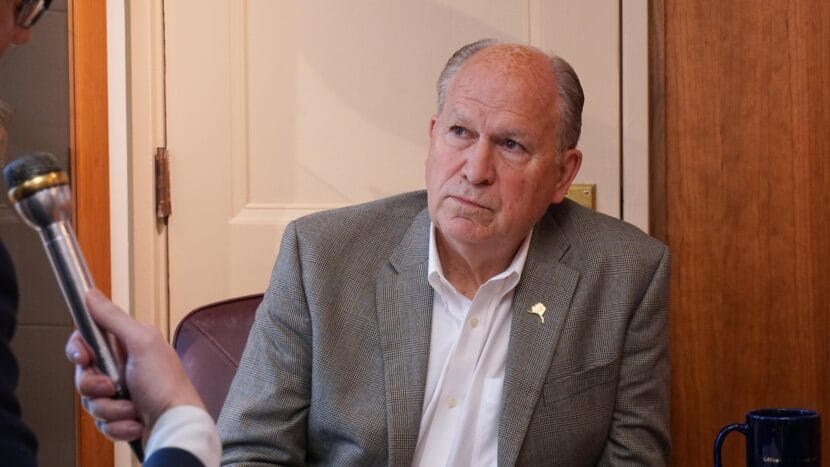
Former Gov. Bill Walker is considering another run for governor. Walker, an independent and former Republican who served one term as governor from 2014 to 2018, filed a letter of intent with Alaska campaign regulators Thursday morning.
It would be Walker’s fifth consecutive run for governor. He lost the Republican primary in 2010, won the gubernatorial race in 2014, suspended his reelection campaign in 2018 and finished third in 2022.
“I have an unquenchable love for my state,” Walker said in an interview.
Walker hasn’t made a final decision on whether to run for the state’s top elected office, he said. The 75-year-old said he’ll wait until the filing deadline on Monday. But Walker said he would “most likely” join the race.
Similar to previous runs, Walker said the state’s longrunning budget issues would be his primary focus.
“Alaska needs a fiscal plan,” he said. “We need to have a plan that we’re not drawing down our savings every year, and … a long-term plan for the future and a stable fiscal regime, rather than the ups and downs tied totally to oil.”
Oil is no longer the largest source of Alaska’s general-purpose revenue, due in part to Walker’s signature fiscal reform during his term as governor, the annual 5% draw from the Permanent Fund to pay for dividends and government services.
Walker pushed the Legislature to pass the percent-of-market-value draw in 2018 on the heels of a steep drop in oil prices that led to a fiscal crisis resulting in Walker vetoing half of the Permanent Fund dividend in 2016.
Oil is still a large source of state revenue, and it’s by far the most volatile. Last year, before the war in Iran, senior budgeters in the Legislature warned of lean times ahead due to a persistent mismatch between the state’s spending and revenue. That’s despite — and to some extent, because of — an ongoing surge in drilling on the North Slope.
Alaskans are living with the consequences of that structural deficit, Walker said.
“We’re seeing people leave our state, an education system that is being significantly underfunded, a marine highway system significantly underfunded,” Walker said. “We’re just hanging on in so many areas.”
Walker outlined a few changes he’d like to see. He’d like to repeal oil tax reforms implemented just before his first term under 2013’s Senate Bill 21, he said, and move to what’s known as a gross tax, a tax on each barrel of oil, rather than a tax on net profits.
The oil and gas industry is “a huge part of our economy, but I think we just need to have better alignment on our resource development,” he said.
Walker said he’d also like to see the state apply taxes to large privately held companies that don’t currently pay corporate taxes.
Notably, Walker did not propose broad-based revenue measures like income or sales taxes.
“We have already gone to Alaskans twice” by reducing the dividend and tapping the Permanent Fund for state revenue, Walker said. “I think we need to look at other streams of income that make sense.”
Walker doesn’t plan to hold large fundraisers or chase down a long list of endorsements, he said. He instead intends to spend most of his time speaking to Alaskans about the need for a fiscal plan.
“This really isn’t about running against anybody,” Walker said. “It’s really about, you know, bringing a fiscal plan into the dialogue during the campaign and see(ing) what Alaskans want to do.”
Walker is the 19th candidate to indicate they’re running for governor. He’s secured a running mate in his former revenue commissioner, independent Randy Hoffbeck, Walker said.
Candidates have until 5 p.m. Monday to officially join the race.