The Alaska House of Representatives on Saturday rejected a Senate-drafted multibillion-dollar tax break for a proposed trans-Alaska natural gas pipeline project, as members of the House declined to abandon a different proposal they drafted.
Members of the House voted down the Senate’s revised bill 12-28, nine votes short of what was needed to adopt the Senate plan. In a separate 0-16 vote, the Senate declined to abandon its version in favor of the House’s plan. Lawmakers will now convene a conference committee with representatives from both bodies to hammer out a compromise agreement.
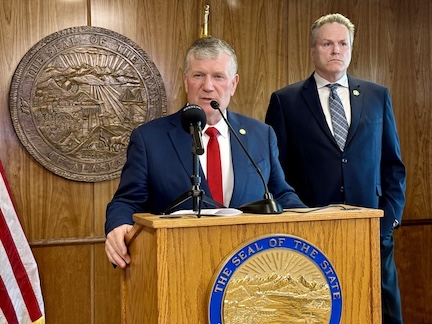
In an interview following the House vote, House Speaker Bryce Edgmon, I-Dillingham, said objections within the House varied, and lawmakers with the conference committee need time to evaluate the changes.
“Given the breadth and just the wide range of things that happened to House Bill 381 in the Senate last night, you know, we’re going to take that vehicle and use it as a starting point going forward, and we’re going to work very diligently and also with a strong sense of resolve to try to bring it all to an agreement,” Edgmon said.
Lawmakers agreed to reconvene for potential final votes on July 1.

While conference committees typically negotiate behind closed doors, Edgmon said there will be public meetings as well.
Lawmakers said negotiations would begin soon but there was no confirmed schedule for the conference committee.
From the House, the conference committee will include Edgmon, Reps. Calvin Schrage, I-Anchorage, and Justin Ruffridge, R-Soldotna. From the Senate, the committee includes Sens. Lyman Hoffman, D-Bethel, Bert Stedman, R-Sitka, and Mike Cronk, R-Tok.
At issue is the size and scope of a tax break for the proposed trans-Alaska natural gas pipeline project, known as Alaska LNG.
As currently proposed, the project would include construction of a 807-mile gas line from the North Slope to Cook Inlet, in phase one. In phase two, it would include a new large gas-treatment plant on the North Slope and an export facility on the Kenai Peninsula to export gas internationally.
The House passed the bill with a larger tax break on June 12. The Senate revised the bill, reducing the size of the tax break and passed a variety of changes on Friday, with a smaller tax break on the gas tax, known as the alternative volumetric gas tax, and a plan for gradual increases in tax over time.
Senators also included a variety of changes to the bill, including a previously contentious provision voted down by the House this spring to levy corporate income taxes on privately-owned oil and gas companies that currently do not pay them. That would apply to Hilcorp and Glenfarne, the company developing the LNG project.
The Senate also included amendments to the bill seeking more protections for the state and Alaskans: one an amendment would limit the gas price cap for residents in Southcentral Alaska to rise with inflation and prohibiting developers from passing on cost overruns to Alaskans; a labor-related proposal would require the pipeline builders to pay prevailing wages in the state and employ Alaskans and apprentices. An amendment would require Glenfarne and developers to disclose their ties to foreign companies. Another amendment declared that if pipeline developers abandon their efforts, the project will return to the state at no cost. Currently Glenfarne owns 75% of the project while the remaining 25% is held by the state-owned Alaska Gasline Development Corp. Glenfarne could not seek a buyout from the state if it failed to move forward with the project.
The Senate imposed deadlines on the project, mandating construction of the pipeline and phase one to be completed no later than 2032, and phase two to be done no later than 2036.

Late Friday night, Gov. Mike Dunleavy voiced objections to the Senate’s version of the bill, saying there were “serious questions about all the amendments.”
Friday was the last day of a 30-day special session devoted to the gas pipeline project. Dunleavy has proclaimed another 30-day special session, which began Saturday, and legislators spent the morning taking procedural actions that allow them to resume work without interruption.
Dunleavy urged lawmakers to work quickly, but four senators were excused absent from Saturday’s votes, and members of the House rapidly left the Capitol on Saturday afternoon in order to catch flights home from Juneau.
Edgmon said he expects negotiations with the governor’s office to continue.
“If he’s not involved, and that’s going to make the pathway ahead problematic,” he said.
A spokesperson for Dunleavy’s office said on Saturday that the governor supports the bill moving forward to a conference committee.
“Governor Dunleavy is encouraged by House and Senate leadership’s decision to send HB 381 to a conference committee,” said Jeff Turner, Dunleavy’s communications director, by email. “It’s an opportunity for both bodies to agree on a version of the bill that can incentivize the Alaska LNG Project while still providing steady, predictable revenue to communities along the pipeline corridor using a volumetric tax mechanism.”
The governor and members of the House were particularly opposed to the corporate income tax provision.

“It is considered economically counterproductive at the moment the state is trying to attract final investment decisions on phase one and phase two of the gas pipeline,” House Majority Leader Rep. Chuck Kopp, R-Anchorage, said on the House floor ahead of Saturday’s vote, adding that he believes the provision undercuts certainty and competitiveness of the project.
“These amendments were not vetted or extensively explained on the other body’s floor, and we do not yet know their full impact,” Kopp added.
But Sen. Bert Stedman, R-Sitka, who co-chairs the Senate Finance Committee said lawmakers still need more financial information from Glenfarne to determine if that’s the case, and to determine the project’s economic viability.
“They still haven’t clearly delineated how much benefit or burden the property tax existing structure actually is on it,” Stedman said after the Senate vote. “Even if we made no property tax on the gas line, it does not make it economic. It helps economics, it does not get it over the hurdle.”
“We gotta protect the treasury, that’s our job,” Stedman added. “If you’re going to give concessions, they need to show us why they need them, and the impact.”
If legislators do not adjourn early, the new special session is set to end on July 19.
James Brooks contributed to this story.
Editor’s note: This story has been updated to clarify the new special session is set to adjourn on July 19, not July 20.