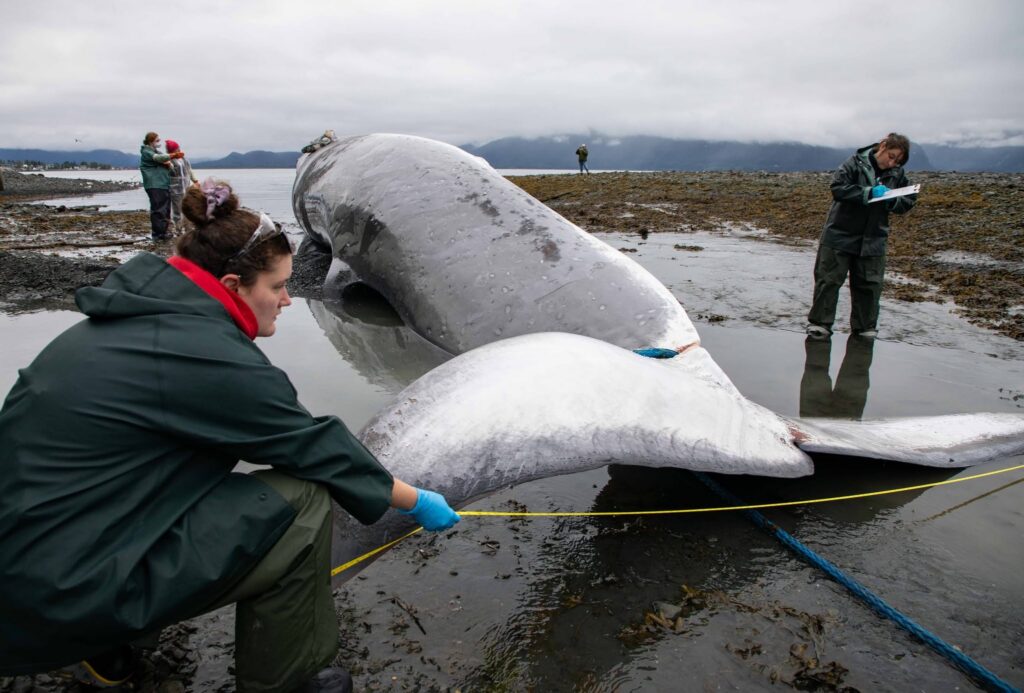
Government regulators and scientists are investigating the death of a fin whale that was carried on the bow of a cruise ship into Seward on Friday.
The dead female whale, measuring 61 feet and apparently pregnant, was moved by local responders to a nearby beach for the investigation into its cause of death, the National Oceanic and Atmospheric Administration said.
NOAA Fisheries and the Seward-based Alaska SeaLife Center are working cooperatively on the necropsy.
While NOAA did not identify the vessel involved, the only cruise ship scheduled to be in Seward on Friday was the Ovation of the Seas, operated by Royal Caribbean Cruise Line.
Royal Caribbean, in a statement, admitted that its ship struck the whale.
“We are saddened to hear that one of our ships struck a whale while on its way to Seward. We take any impact to marine ecosystems very seriously. The ship immediately reported the incident to the proper authorities. We are cooperating fully with NOAA and are awaiting the necropsy results,” a company spokesperson said by email.
Fin whales are listed as endangered under the U.S. Endangered Species Act. They are the world’s second-largest whales, after blue whales, according to NOAA. The agency lists ship strikes among the top threats to their populations.
Ship strikes have killed numerous whales in Alaska in the past. A 2012 NOAA report said there were 108 reported whale-vessel collisions in Alaska from 1978 to 2011, and nearly a quarter of those killed the whales. Those events included strikes by cruise ships, such as a 2010 case involving a Princess Cruises ship.
A 2024 NOAA report on human-caused, nonhunting deaths to Alaska marine mammals tallied 41 probable deaths of humpback whales between 2018 and 2022, along with numerous deaths of other whale species. Data in the report indicated that more than two dozen whales were killed by ship strikes in that period.
For environmentalist Rick Steiner, the Seward case on Friday is further evidence supporting the need for ship speed limits in important whale habitat off Alaska.
Steiner, a retired University of Alaska marine biologist who now heads an organization called Oasis Earth, has been campaigning for speed limits for several years. If not mandatory, as they are on the East Coast to protect endangered Atlantic right whales, he said they could be voluntary, as they are in areas of California.
Those speed limits have been effective, Steiner said.
The problem of ships striking whales is widespread, he said. “The number of times you see a whale deal and pinned on the bow of a ship, either an oil tanker or a cruise ship, is only the tip of the iceberg,” he said.
Steiner and others, including the Prince William Sound Regional Citizens Advisory Council, have been seeking to establish speed limits for a variety of vessels in places like Unimak Pass, Icy Strait, Prince William Sound and Resurrection Bay, where whales congregate but where there is also heavy ship traffic at certain times of the year.
Those limits should be set at 10 knots in daytime and 8 knots when visibility is low, he said. That compares to the normal sailing speeds of up to 20 or 22 knots for cruise ships and 15 to 17 knots for oil tankers, he said.
However, regulators and industry groups have not agreed to any such limits, as voluntary guidelines, he said.
Steiner said he appreciated Royal Caribbean’s statement acknowledging that its ship struck the whale.
“But what are they going to do about it is the question,” he said. “If Royal Caribbean is genuinely contrite and wants to do something about it, we know what that is.”