
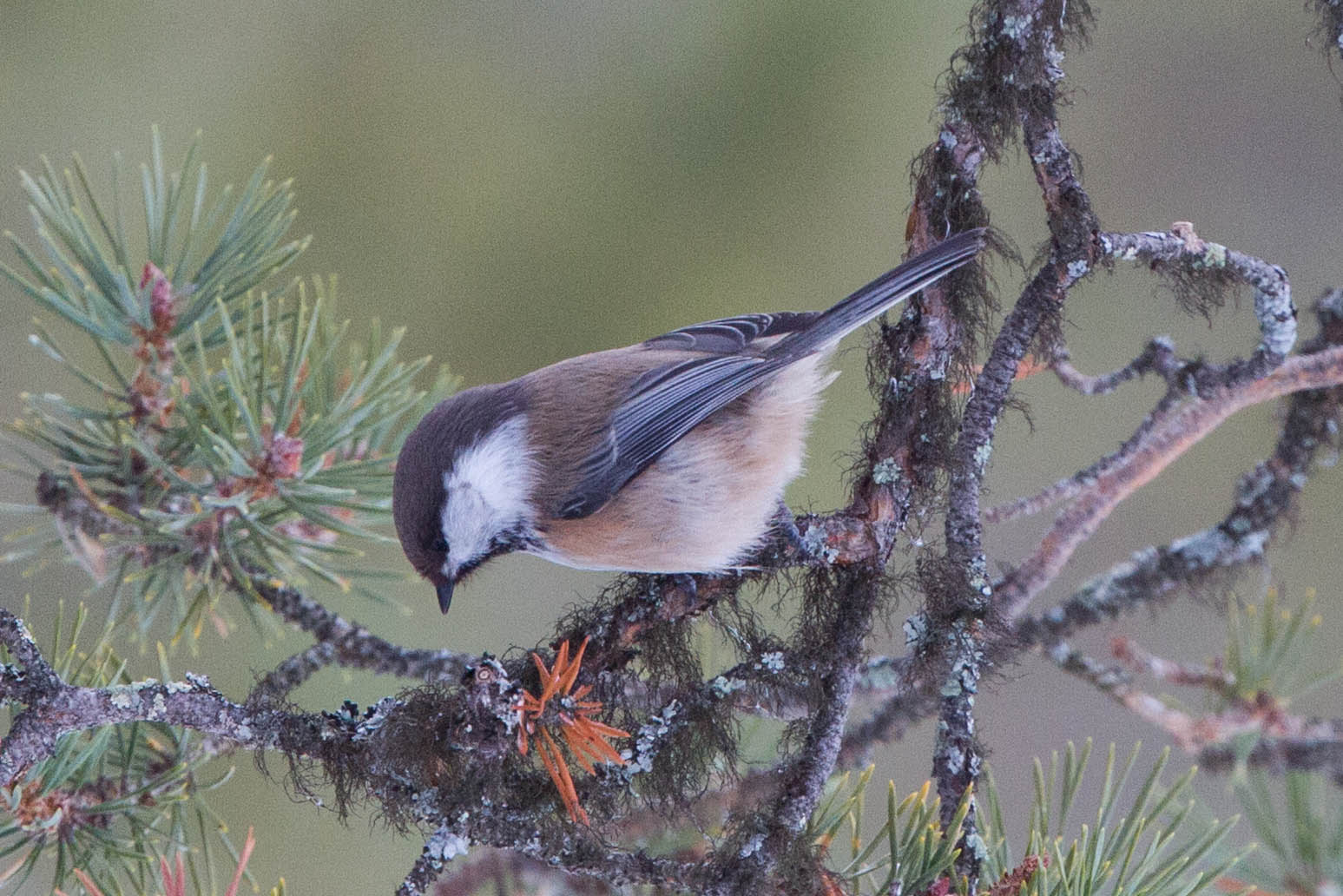
Environmentalists are seeking Endangered Species Act protections for an Arctic-dwelling bird that has not been documented in Alaska since 2018.
The Center for Biological Diversity last week submitted a petition to the U.S. Fish and Wildlife Service requesting an endangered listing for the gray-capped chickadee, a bird that dwells on the northern edge of the boreal forest.
Gray-headed chickadees, formerly called Siberian tits, are small songbirds found mostly in northern Eurasia. They used to be common in Alaska and Canada but have become scarce in North America.
The Canadian government listed the species as endangered in 2024, citing the species condition in the Yukon Territory as “critical.” Models indicate that there are fewer than 250 mature gray-headed chickadees remaining in the nation, according to Environment Canada.
The Alaska Department of Fish and Game counts the gray-headed chickadee as a high-priority “species of greatest conservation need” and has been studying the decline through its Threatened, Endangered, and Diversity Program.
But the U.S. federal government has yet to take meaningful steps to protect gray-headed chickadees, the listing petition said.
“Inaction is causing gray-headed chickadees to drift toward disappearance. Given the gravity of the situation, the continued survival of gray-headed chickadees in North America requires increased protections,” said the petition, filed June 25.
Gray-heeded chickadees are particularly adapted to the cold, with heavier plumage than other songbirds, an ability to lower their body temperatures to conserve energy and burrowing behavior, possibly within snow, that allows them to take shelter, according to the Department of Fish and Game.
While the last Alaska documentation was eight years ago, there is still time to save the gray-headed chickadees in the state, said Cooper Freeman, Alaska director for the Center for Biological Diversity.
“I think it’s far too early to say that it’s gone,” Freeman said.
An Endangered Species Act listing would help find and protect the last remaining birds and their habitat, he said.
And while extinction of the gray-headed chickadee would be “an absolute tragedy,” the concerns reach beyond that species, he said.
“I think we see the gray-headed chickadee as a flashing red light, sentinels of the Arctic, from the top to the bottom,” he said.

Climate change is cited as a major factor in the gray-headed chickadees’ decline, both in the listing petition, as well as by Alaska and Canadian biologists. Climate change affects chickadees’ specialized habitat at the northern edge of the tree line, where they live year-round, and it has increased the frequency of icing and other extreme events, biologists say.
The Center for Biological Diversity’s listing petition says that the Trump administration’s policies, along with exacerbating rather than addressing climate change, are creating other risks for the rare birds.
One policy is promotion of the Ambler Access Project, which would develop a new road extending more than 200 miles into the Brooks Range foothills to connect isolated Arctic mining prospects to the state’s road system. That new road and its associated traffic and other impacts would cut right through the gray-headed chickadee’s specialized habitat, Freeman said.
Other proposed development that poses direct threats to gray-headed chickadees includes mining projects, which are now easier to start under new Department of the Interior policies, according to the listing petition. The proposed pipeline to carry natural gas from the North Slope, a project pursued for decades, would also harm the birds by cutting directly through their habitat, the petition said.
Freeman said oil development on the North Slope, including possible development on the coastal plain of the Arctic National Wildlife Refuge, is not a direct threat because the gray-capped chickadees’ natural habitat is more boreal than tundra. However, the center considers additional oil and gas development in Arctic Alaska to be an indirect threat because it would accelerate climate change, he said.
Under the Endangered Species Act, agencies have 90 days to decide whether a listing petition merits further review. If it does, the act has a 12-month deadline for a decision on whether to recommend listing.
Teri Balser, a U.S. Fish and Wildlife Service public affairs specialist based in Fairbanks, said the service does not comment on newly filed listing petitions.
While the gray-headed chickadee is not currently listed under the Endangered Species Act, “it is considered a bird of conservation concern under the Migratory Bird Treaty Act,” a classification that indicates it is a conservation priority, Balser said by email on Tuesday.
This article has been updated with a response from the U.S. Fish and Wildlife Service.