The National Transportation Safety Board on Thursday released the final report for the February 6, 2025, accident involving Bering Air flight 445 that killed all 10 people on board.
While the NTSB’s report identifies airspeed and load issues as the main causes of the crash, the Alaska aviation community is still reeling over how it could have happened with such a well-trained pilot from a company with an excellent safety record.
The Board determined the crash was caused by the pilot’s inadequate airspeed management and operation above gross weight. It also faulted the company for allowing overweight operations and the Federal Aviation Administration for inadequate oversight.
The Board’s team was composed primarily of investigators from outside the Alaska region, which is not uncommon when an accident is considered significant. But their lack of familiarity with the state’s aviation industry was evident in interviews as they sought to understand daily operations in rural Alaska. They also did not know about Bering Air’s unique reputation as, statistically, one of the safest small commuters in state history.
While Alaska has had a challenging flight safety record for decades, that was not the case with Bering Air prior to this accident. That is what has made the crash of flight 445 so shocking to the aviation community here, and has led it to more nuanced scrutiny into the cause of this crash.
Airspeed
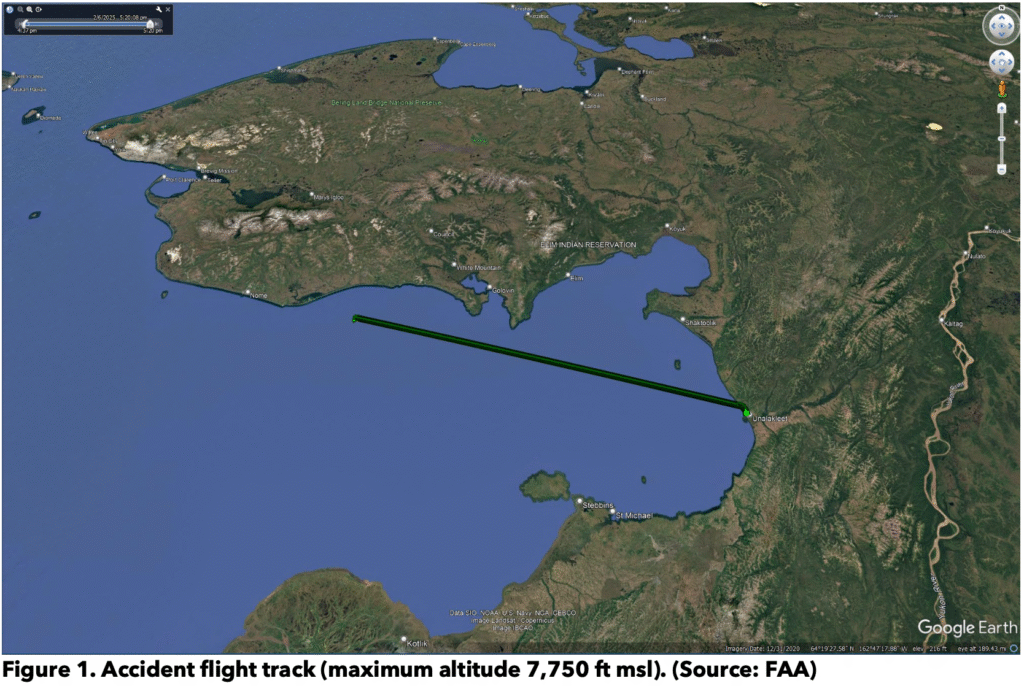
That February afternoon, Flight 445 departed Unalakleet for Nome at 2:37 p.m. in a Cessna Caravan. Pilot Chad Antill was not an inexperienced pilot, but he wasn’t a seasoned veteran either. He began flying for Bering Air in 2022 and had about 2,500 total hours of flight time with 1,060 hours in the Caravan — flight hours are incredibly subjective as a measure of experience and dependent on a variety of factors including the type of flying, type of aircraft and location. At 3:05 p.m. Nome reported light snow, broken ceiling at 2,700 ft, overcast ceiling at 5,500 ft, and visibility of 10 miles. An icing forecast issued at 1 p.m. noted constant moderate icing between 2,000 and 8,000 feet in the region. Trucks were active on the runway and taxiways to keep surfaces clear for landing aircraft.
Flight 445 initially proceeded without incident and at 3:11 p.m. the pilot contacted Anchorage Center while descending from 7,725 feet for Nome. At 3:13 p.m., according to data obtained after the accident from the onboard Garmin 1000 flight system, the aircraft was flying at 163 knots and 6,575 feet. The Anchorage controller notified Antill that Nome Flight Service was reporting the available runway was closed for 10 to 15 minutes for snow removal and he might want to slow a bit to “not get there too early.”

The aircraft’s speed then decreased to 152 knots; it was reduced even further to 111 knots two minutes later — below the required Caravan speed of 120 knots for known icing conditions. At 3:16 p.m., Anchorage cleared the flight to descend at pilot’s discretion and maintain 4,000 feet. Antill gave a “good readback” of the instructions to the controller. Then, in one minute, things get out of control. At 3:19 p.m., the air speed briefly climbed to 121 knots; the aircraft was entering a rapid descent — an extremely dangerous situation. The last data point from the Garmin 1000 was at 3:20 p.m. when it reported 200 feet and 52 knots. The wreckage was later found about 34 miles from Nome on the sea ice.
Weight
In its investigation, the NTSB used data from several sources, including the Garmin, to conclude that the flight was about 800 pounds overweight out of Unalakleet for standard operations and 1,000 pounds overweight for flight into known icing conditions. There are different weight standards for flight into known icing conditions. Based on the Garmin data, the agency also asserted that flights on five previous days, which involved pilots other than Antill, were also overweight. That information generated significant attention when released to the public earlier this year, effectively directing the conversation onto fuel weight.
Weight can become a factor in conjunction with some other event or action. For example, if the aircraft is loaded improperly, as in the 2013 Soldotna accident, or if an aircraft suffers a mechanical failure, or encounters severe weather conditions.
It’s tough for FAA inspectors to check the weight on flights — they would need reasonable cause to unload the plane. The air service bears the responsibility for every load as it is company employees who manage those loads. For the FAA, Garmin data is not easily available, and absent reasonable cause an inspector cannot demand a company unload and weigh everything onboard an aircraft. This would be particularly onerous in Alaska where combinations of passengers, freight and mail are common. How the FAA can accomplish load oversight, without being unduly invasive on daily operations, is a question the NTSB is not required to address but the FAA will likely puzzle over for some time.
It is indisputable Antill was flying heavier than his flight manifests reflected on February 6. While the Garmin 1000 is not infallible, based on the fuel weight he ordered when he departed Nome that morning and standard fuel burn calculations for his flight from there to St. Michael’s and then on to Unalakleet and back to Nome, the aircraft was overweight.
However,it is the air speed in icing conditions that should command the most attention from the report. Understanding air speed, many Alaska pilots say, far more than weight, is how to prevent future accidents like flight 445.
Flying in icing conditions
The Caravan was equipped with an aircraft deicing system, the Tecalemit-Kilfrost-Sheepbridge Stokes, named for the three British companies that first invented the process in 1942. The system, which is used to prevent ice from adhering to, and consequently building up on, wing surfaces and the tail assembly, is not designed for prolonged flight in icing conditions. Instead, it is intended to protect the aircraft while the pilot exits them. According to the Cessna Caravan Aircraft Flight Manual, even with the TKS deicing system on, the minimum air speed when icing has been encountered is 120 knots. From 3:15 p.m. until the crash, flight 445 failed to maintain that air speed.
In NTSB interviews with several Bering pilots, management and the company’s FAA-assigned Principal Operations Inspector, the question of minimum air speed in icing conditions came up repeatedly. In each instance, the response was that 120 knots was the minimum acceptable. Not only was 120 knots listed in the Caravan manual but also in Bering Air’s checklist, standard operating procedures and its cold weather training materials. As one pilot told investigators, “…120 is what is the minimum recommended by Cessna so obviously that’s the minimum that would be recommended by the company.”
To try and understand why Antill remained in icing conditions even as the aircraft slowed down, the TKS deicing system was discussed frequently in interviews. The regularity of icing forecasts in large swaths of Alaska was also addressed, along with the need for pilot reports to confirm or refute forecast validity. As the company’s operations inspector explained to investigators in the report: “We have forecast weather issues. Big State. Broad Forecast. Lots of changing weather.”
Absent a confirmation pilot report, pilots depart into forecasted but not yet confirmed icing conditions. The TKS deicing system was designed exactly for this sort of potential icing environment. But, according to Chris Magerkurth, a former engineering specialist with Cessna who had seventeen years with the company working on ice protection systems, pilot over-reliance on systems like TKS is a concern. “The systems are designed to provide brief encounters with icing, not to hold or fly around indefinitely in any icing conditions,” he explained to me. “A pilot has no idea what ice conditions they are in or how quickly those conditions can change. They need to ask for a higher or lower altitude and get out of it.”
It is possible that the prevalence of icing conditions in the Norton Sound area has led to a subtle perception of the TKS deicing system as more “anti-ice” than “escape from ice” among pilots there. Coupled with the fact that many Alaska companies fly single-pilot aircraft, over-reliance on equipment like TKS while in tough conditions might be happening. This is especially true among the current generation of pilots who learned to fly in cockpit environments that emphasize automation. If anything is to be taken from this accident, many pilot sources stress, Cessna’s mandate to escape icing as quickly as possible would be the primary message, regardless of the accessibility to TKS.
In its recommendations, the NTSB called for the FAA to develop certain “surveillance criteria” for small commuter or charter services, known as Part 135 companies, who experience what the Board describes as “rapid growth, increased complexity of operations, accidents and/or incidents,” etc. But as he discussed with investigators, Bering Air’s operations inspector was physically present in Nome one week of nearly every month and the company had not markedly altered its route structure in recent years, even after the bankruptcy of Ravn Air Group in 2020.
Further, based on a review of the NTSB’s database, Bering has maintained for decades the safest record among any small commuter or charter service of similar size in the state. Prior to flight 445, Bering was involved in seventeen accidents in the previous thirty-five years with only two in the previous ten years. There were no fatalities and only one serious injury when a passenger intentionally walked into a spinning propeller. In comparison, the company with the worst record in the period, Hageland Aviation Services, had 43 accidents before it went out of business in 2020 as part of Ravn Air. There were 29 fatalities and seven serious injuries in those crashes, its last occurring three months before the company shutdown. As Bering’s operations inspector noted to investigators, the company did not exhibit “risk indicators.” That is part of what made the crash of flight 445 so shocking. Simply put, Alaskans did not see this one coming.

Unanswered questions
A well-trained pilot with a seemingly reasonable amount of experience and reputation, according to his co-workers, for conservative flying, departed Unalakleet overweight into forecasted moderate icing conditions. He flew directly across Norton Sound rather than choosing one of Bering’s approved shore routes. When asked to “slow down a bit” by Anchorage Center he did not respond that conditions made such a request unacceptable. When told minutes later to descend at his discretion he agreed rather than ask for an immediate altitude out of the ice. He never declared an emergency. There is no record of him contacting Nome Flight Service to ask the trucks to leave the runway so his landing would not be delayed, which is a common request in such situations in Alaska. Finally, for several minutes his air speed steadily decreased and he appears to have done little to stop it, or to alert anyone that he was in trouble.
For people familiar with the aviation industry in Alaska, this behavior is troubling and frustrating to contemplate. In its recommendations the NTSB said nothing about further training in icing conditions. It is unclear what more could have been done to stress the importance of 120 knots in the Cessna Caravan.
Magerkurth was part of the group that certified various anti-ice and deicing equipment over the years, including on the Cessna Caravan, and his thinking is quite straightforward: “The minimum icing air speed as set by the manufacturer is based on the changes in aerodynamic characteristics of the airframe such as drag created by various ice shape configurations,” he explained. “The company tests worst case scenarios based on the continuous maximum and intermittent maximum icing envelopes developed in federal regulations. When it sets an air speed limit, it is the result of that research.”“The limit,” he said, “cannot be ignored.”
Editor’s note: The author worked with the principal operations inspector, who is a source in this story, at Larry’s Flying Service in Fairbanks in the 1990s.