Canada’s Arctic Archipelago saw some record-high temperatures in winter 2025, even as parts of north-central Canada were colder than average during the season.
The Canadian findings are part of the “State of the Climate in 2025” report, released this week by the American Meteorological Society.
“During winter, record-high temperatures were found over the Canadian Arctic Archipelago and the southern Barents Sea,” the report said.
Meanwhile, north-central Canada shared its below-average winter temperatures with just one other place—eastern Siberia.
In its chapter on the Arctic, the report said 2025 was the second-warmest year on record since 1900, with annual surface air temperature 1.38 C above the 1991–2020 average.
It was the 12th consecutive year that Arctic temperatures were farther above average than temperatures globally.
“The Arctic observed its second warmest year, with records dating to 1900,” the report said. “Arctic surface air temperatures are increasing about three times faster compared to the entire planet.”
Record warmth around Baffin Island
The report describes autumn in the North Atlantic part of the Arctic as “anomalously warm.”
Temperature anomalies in the Arctic section of the report refer to differences from the 1991–2020 average.
Baffin Bay and Baffin Island in Canada particularly stood out, with record-high temperatures going up to as much as 6C above average.
Records were also set in the eastern Lincoln Sea and central Arctic Ocean, while parts of central Greenland, the Denmark Strait and western Eurasia saw record warmth, though with smaller temperature anomalies.
But it wasn’t just temperatures that stood out in northern Canada.
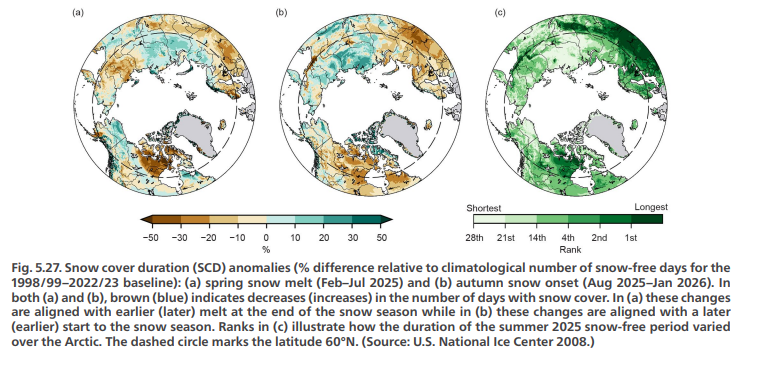
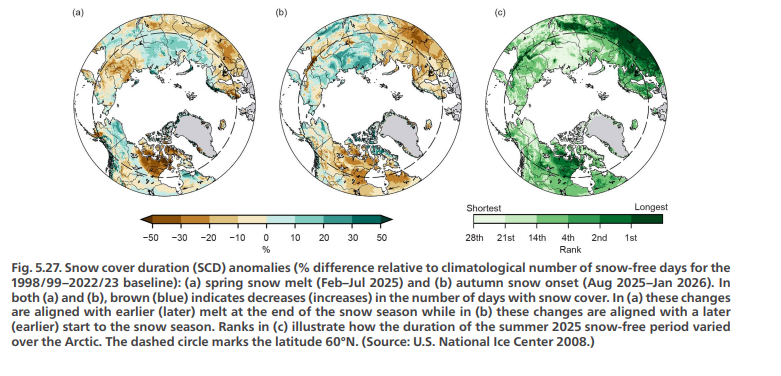
The southern part of Canada’s Arctic recorded an earlier than normal spring melt and a later return of snow in the fall, leading to one of the longest summer snow-free periods in the available record, the report said, a pattern that was also seen in western Eurasia in 2025.
Meanwhile, below ground, permafrost temperatures reached record highs at two of four sites in Canada’s eastern and High Arctic.
Overall, the four sites have seen an increase of up to 1 C a decade, the report said.
The “State of the Climate” report is put out annually.
This year’s edition includes contributions from 625 scientists in 60 countries.
Comments, tips or story ideas? Contact Eilís at eilis.quinn(at)cbc.ca
Related stories from around the North:
Canada: Extreme cold weather won’t stop some Yukoners from getting their jobs done, CBC News
Finland: Unusually balmy June comes on tail of Finland’s record spring warmth, Eye on the Arctic
Norway: Weather above normal for 18 consecutive months, The Independent Barents Observer