
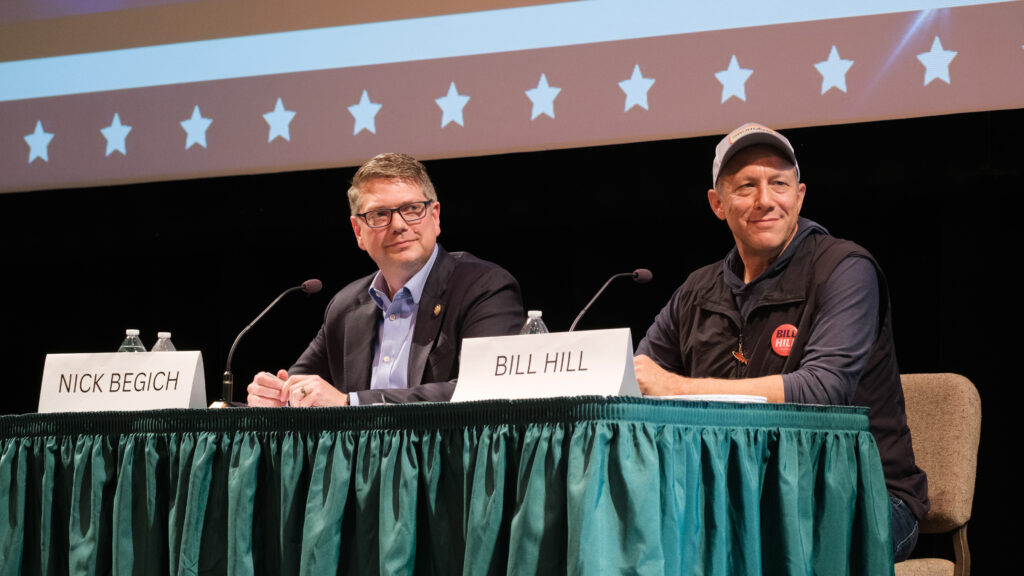
Front-runner candidates for Alaska’s sole U.S. House of Representatives seat expressed strong support for the fishing industry and coastal communities at a debate in Kodiak over the weekend.
Incumbent Republican U.S. Rep. Nick Begich III and independent challenger Bill Hill took very similar positions on issues including fisheries bycatch, declining fish stocks and representation in federal fisheries management, but there were some differences.
Begich touted his legislative record in his first two-year term as beneficial to Alaska fisheries, while Hill said his personal history as a lifelong fisherman in Bristol Bay is advantageous for representing Alaska in Congress.
Begich, a technology entrepreneur and business executive, garnered 44.6% of the vote in the primary election, while Hill, a former school superintendent and commercial fisherman, received 32.5% of the vote. Third and fourth place finishers in Alaska’s ranked choice general election include Eric Hafner — a registered Democrat serving a federal prison sentence in New York – with 3.8% of the vote, and Libertarian Jim McDermott of Fairbanks with 1.2%.
The winner of the November election will serve a two-year term as one of the 435 members of the U.S. House of Representatives.
Begich promoted his legislative record as a freshman in the Republican-controlled U.S. House. This spring, six bills he sponsored passed Congress to become law — a tie with another Arizona lawmaker for most bills passed as a freshman — but none of those bills directly address fisheries issues.
“I have passed more legislation than any freshman on record,” Begich said. “And those are good Alaska bills — they are bills that unlock lands for Alaskans, and they are bills that, in many cases, we’ve been working to achieve for decades.”
Hill repeatedly referenced his experience growing up subsistence and commercial fishing in Bristol Bay. “I raised three of my kids on my fishing boat, and understand the importance that state, national and international politics play in what happens on our back decks with our children, what happens in the income that we can take home, what taxation does to us, what tariffs do to us,” he said. “I’ve lived a life of fish.”
Bycatch
Several debate questions focused on bycatch, the accidental harvest of nontargeted fish. Bycatch has raised public concern around Alaska’s industrial trawl fleet, which has many vessels harbored in Kodiak, where the debate took place.
Both candidates said they support broader representation on the North Pacific Fishery Management Council, which oversees fishing policy in federal waters, including bycatch regulations.
Begich said he supports increasing representation for subsistence, sport fishers and small commercial operators, as well as large operators, in council decisions. He pointed to a bill he introduced, the Bycatch Reduction Act, which would require the council to implement gear performance standards to reduce bycatch, to make investments in fishing gear and fisheries research and to increase monitoring and reporting from the industry and the council, among others.
“We need transparency — more transparency for folks who may have conflicts of interest that currently serve on the NPFMC,” Begich said. He also expressed support for a chum bycatch limit established by the council this year for the Bering Sea pollock fishery.
Hill said he supports bycatch limits to protect salmon runs, and additional seats representing subsistence and tribal groups.
“Subsistence is sacred, and the very first thing that needs to happen, and I think you hear it from across the state — this is why there’s such a loud outcry — is because some of our subsistence users have not been able to access their resource, which is more than just protein, for quite a few years now,” he said.
In a question about Congress’ role in reducing bycatch, debate moderators noted all fisheries produce some bycatch harvest and said “a goal of zero bycatch isn’t reasonable.”
But both candidates pushed back on that framing and said that zero bycatch should be the ultimate goal.
The industrial trawl fleet, particularly boats that target pollock, has been the focus of public criticism because it contributes substantially to the state’s bycatch numbers for species including juvenile halibut, cod and salmon returning to spawning grounds throughout Alaska.
Begich said he agreed that every fishery produces some level of bycatch and it’s up to the council to manage each complex fishery. But he said the goal should be “aggressive.”
“I do think the goal should be zero. It’s going to be a long road to get there. But we also have to recognize that in every single fishery, whether it be subsistence, sport, small commercial or large commercial, they have a bycatch responsibility as well,” Begich said.
Hill said the goal should be zero bycatch. “We need to work towards that. We need to work towards a very low-threshold for our trawling industry, especially the out-of-state corporate trawlers,” he said.
And Hill expressed confidence that the trawl industry would be able to meet required limits.
“My perspective is when you set something out for industry to accomplish, they always find a way, and we’ve seen over and over again that our trawl fleet has met the standards that are being set for them. So, can we get to 0%? That would be everybody’s desire, but should we be working towards it? Yes, we should be,” Hill said. “But those who are bad actors, you’ve got to leave the fishery.”
When asked about the primary causes of king and chum salmon run declines, Begich responded it was “largely bycatch related.”
“You look at the Yukon, you look at the Kuskokwim — those runs are way down. We’re seeing some recovery in chums. I think that the cap that we put in with NPFMC is sort of that initial shot saying, ‘Hey, we’re going to be managing these more carefully,’” Begich said. “But I think that historical bycatch is the root cause.”
Hill said he agreed, and added that climate change driven factors are affecting Alaska’s salmon runs. “Climate change is a real thing, and we need to start mitigating for that,” he said. “But yes, we need to end bycatch.”
Processing and protecting Alaska’s fisheries
Both candidates said they would support investments in building the workforce in fishing and processing sectors, as well as more visas for hiring international workers in processing.
In a lightning round of questions, the candidates agreed on every issue. They supported science-based fisheries management, more investment in research and engaging with a wide range of fisheries interest groups prior to introducing new legislation or policies. They also agreed that rural and tribal communities should have more say in decisions affecting fish.
When asked how they would ensure the economic value of federally-managed fisheries would not come at the expense of Alaska communities, Begich said he supports labeling rules for farmed vs. wild-caught fish.
“Alaska seafood is competing with penned fish and farmed fish, and the end consumer doesn’t know it,” Begich said. “And so, when you’re buying an Alaska seafood product, we need to make sure that it’s labeled Alaska. That’s transparent because it gives us the best price for our product and it reduces some of the pressure on our fisheries.”
Hill said he would support more investment in in-state seafood processing to diversify processors to which fishing fleets can sell their harvests. “More processing in our state that’s not a consolidated, vertically integrated type of processing,” he said. “And we need to make sure that we’re legislating to make sure that farmed fishing does not come to our seas and that we keep them off for as long as we possibly can.”
Geopolitics
Both candidates expressed support for tariffs on international seafood to protect Alaska markets.
Hill also condemned the U.S. war in Iran for driving high costs of fuel and affecting fisheries.
“The Iran war is a terrible, terrible thing in terms of how it’s impacted our industry,” he said. “The fuel costs I paid this summer were $2 per gallon more than last year, and they were already high. And then we start talking about things like food and groceries, and the things that allow our crews to do good work for us while we’re fishing hard.”
Begich has expressed support for the Trump administration’s military action against Iran, and voted against a war powers resolution that passed Congress in June calling on President Donald Trump to remove armed forces against Iran, unless authorized by Congress or a declaration of war.