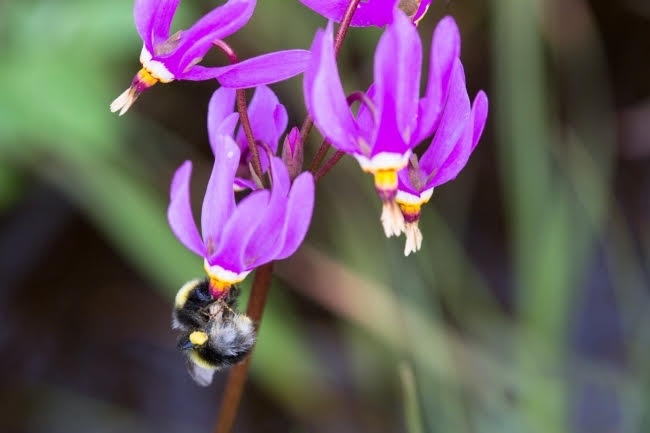
Alaska’s short summers demand fast, resilient pollinators — and few species meet that challenge as well as our native bumblebees. These insects are active in cold, windy, and unpredictable weather that keeps most other pollinators grounded. Their ability to generate heat, forage in low temperatures and fly long distances makes them essential to the health of Alaska’s wild landscapes.
Bumblebees pollinate blueberries, cranberries, fireweed, lupine, geranium and many tundra plants that wildlife depend on. Without them, berry production would drop, wildflower reproduction would falter and entire food webs would feel the impact.
Unlike honeybees, which rely on large colonies and stored honey, Alaska’s bumblebees survive with small annual colonies that die back each winter. Only newly mated queens overwinter, tucked beneath moss, soil or leaf litter. In spring, each queen must start a colony from scratch — building a nest, laying eggs and foraging alone until the first workers emerge. Their thick hair, large bodies and ability to shiver their flight muscles allow them to warm up and fly when temperatures are still in the 40s. This cold‑weather resilience is why bumblebees dominate northern ecosystems.
Alaska hosts more than 20 species of bumblebees, including the Arctic bumblebee, Bombus polaris, which can forage on cold, cloudy days; Bombus balteatus, a long‑tongued specialist of deep flowers; Bombus mixtus, common in forests and meadows; and Bombus occidentalis, once widespread but now in decline in parts of its range. Each species plays a unique ecological role, and many are important indicators of environmental change.
Even in Alaska’s remote landscapes, bumblebees face pressures. Climate change is altering the timing of plant blooms, creating mismatches between flowers and pollinators. Habitat loss from development and wildfire reduces nesting and foraging areas. Pesticide exposure remains a concern, especially near agricultural or managed landscapes. Disease transmission from managed bees — including commercial colonies brought north for pollination — poses additional risks. These challenges are documented by agencies such as the U.S. Geological Survey and the U.S. Fish and Wildlife Service.
Supporting bumblebees does not require large‑scale intervention. Protecting natural habitat, reducing pesticide use and planting native flowers can help maintain healthy populations. Home gardeners can make a difference by leaving small patches of undisturbed soil or vegetation for nesting queens and by choosing native plants that bloom from spring through fall.
Bumblebees are more than pollinators — they are keystone species. Their decline would ripple through Alaska’s ecosystems, affecting berries, wildlife and the cultural traditions tied to the land. Understanding their importance is a first step toward ensuring they remain part of Alaska’s future.
This commentary is the first in a six‑part series on Alaska’s native bees.