Arctic islands are sometimes places where the world comes together, whether in the form of a Norwegian-Russian post office or multilingual classroom in Longyearbyen. But they are also sometimes places where the icy seams of the world start to show.
At the Norwegian post office in Barentsburg, a Russian flyer taped to the glass door invited passers-by to an upcoming event commemorating the 80th anniversary of the end of the Second World War – or the Great Patriotic War, as it’s known in Russian. “Take part in the ‘Victory’ test!” it urged. “Test your knowledge of the military history of the fatherland – To know is to remember!” Outside, a middle-aged woman dressed in the standard babushka winter attire of a long parka and fuzzy hat stood stoically in the cold.
Only at a post office on Svalbard could I buy Norwegian stamps in what felt like the innards of the Russian Arctic. This might not exactly have been what Soviet leader Mikhail Gorbachev had in mind when he called for the Arctic to become a “zone of peace,” but it was a form of circumpolarity nonetheless.
From Longyearbyen to Barentsburg by boat
I had reached the largest Russian settlement on Svalbard by boat from Longyearbyen on a clear blue day in May 2025, when Henningsen Transport & Guiding was still offering such cruises. (A slew of angry Google Reviews suggests that the Norwegian company stopped running them sometime that spring and took months to offer refunds, but the company calendar indicates that they will resume in August 2026). Henningsen was still leading its tours despite the boycott of the Russian state-owned company that operates Barentsburg by Visit Svalbard, the archipelago’s official tourism agency.
Already in Longyearbyen that morning, Svalbard’s cosmopolitanism had colored the start to my day. A gaggle of children making their way to school looked to be Ethiopian, Filipino, and Norwegian. My hearty hotel breakfast of sweet, brown cheese stirred into a bowl of porridge was cooked by a Filipina lady. And onboard our cruise was a mix of German, Dutch, and French tourists – and two Chinese sightseers, for whom we actually had to return to port soon after departing since they had literally missed the boat.
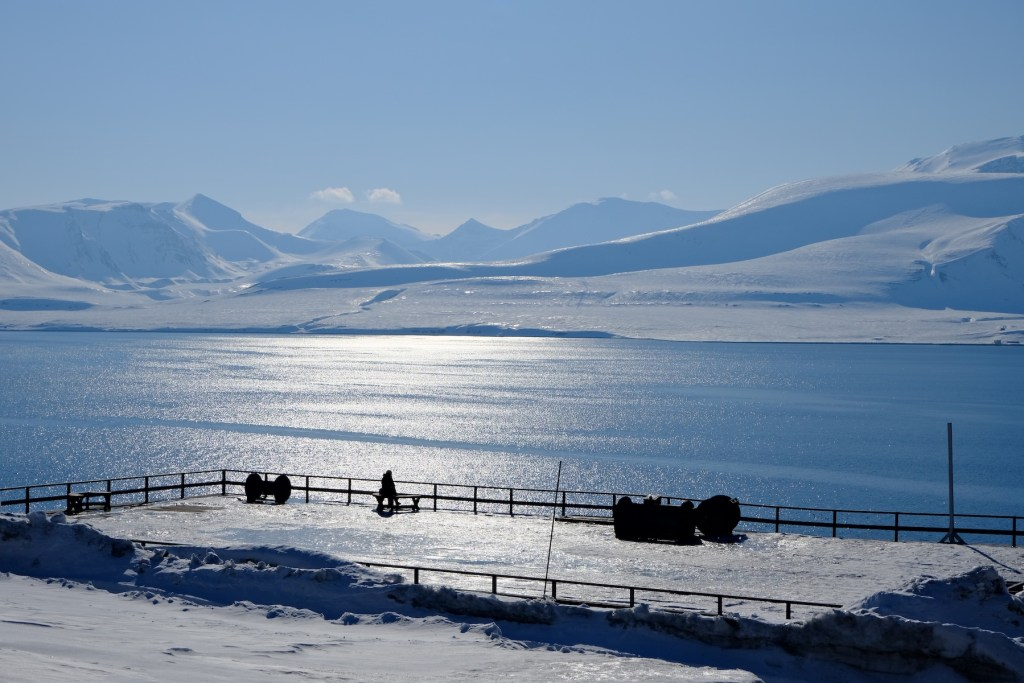
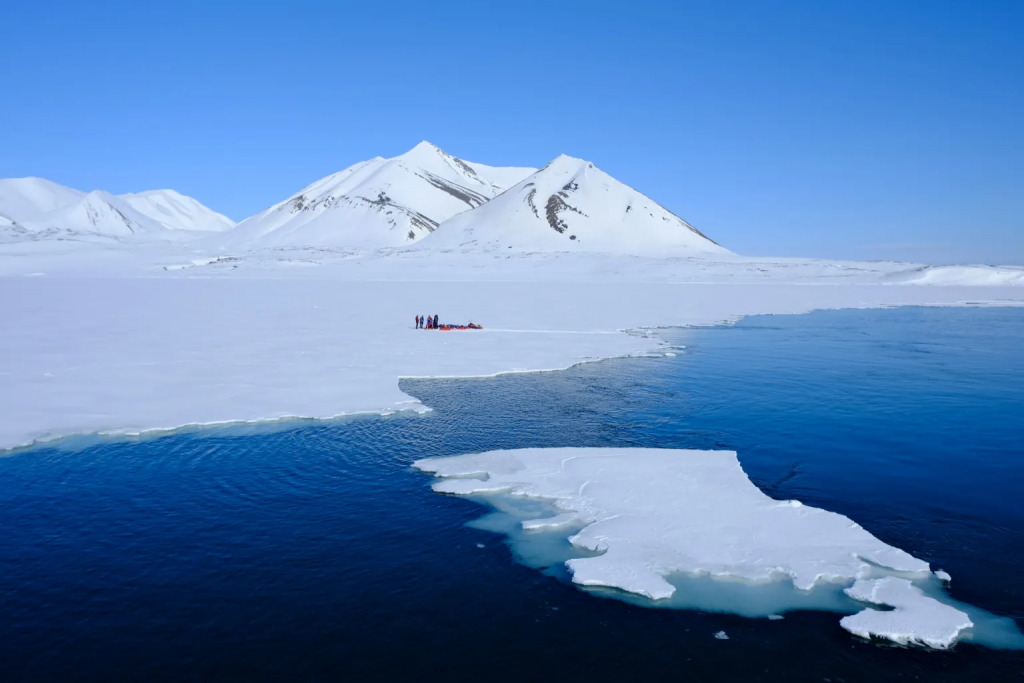
Once we were truly en route, we sailed for a few hours towards Green Fjord, named after the chlorophyllic shade the fjord walls turn in summer after months of fertilization by the rich droppings of little auks and black guillemots. (Climate change is making Svalbard greener, so the name should stick for years to come.) On the way, at the foot of a glacier calving into the sea, we dropped off a group of British skiers who were about to begin a week-long traverse of Svalbard. We also passed a walrus and her pup sitting on an ice floe, which made the cruise feel like a mini-safari.
In Barentsburg, coal mining carries on
Before even spying Barentsburg, we spotted a plume of dark smoke rising from the east side of the Green Fjord. Its origin was a coal mine that now reaches 600 meters below the fjord’s floor. While the Norwegians stopped mining coal on Svalbard in 2025, the Russians dig on. Ukrainian miners used to be a play a big part in this effort, but almost all have left since the full-scale invasion of their country in 2022.
As we pulled into port, our guide, a young Russian woman named Katya (name changed), greeted us with a smile as bright as her high-vis vest. She led us from the docks up a rickety set of wooden steps to town, where she began explaining how she ended up at the top of the planet. Originally from Petrozavodsk, a city in the northwest Russian Arctic that I visited in 2015, Katya first went to work in Pyramiden, the defunct Russian coal mining town 100 kilometers to the west. Now, she lives in Barentsburg and “loves it.” Katya said that since she has a boyfriend, she is able to rent a proper flat. “If you’re single, you just get a small room,” she explained. “When I first got to my room, the chair broke.”
I suppose this means that Katya met someone in a town of just 350 people. Having only one canteen, where many residents take meals three times a day, must make that pretty easy. And when love means you get to move on up, that’s a pretty good two-for-one.


A walk down memory lane – in Svalbard
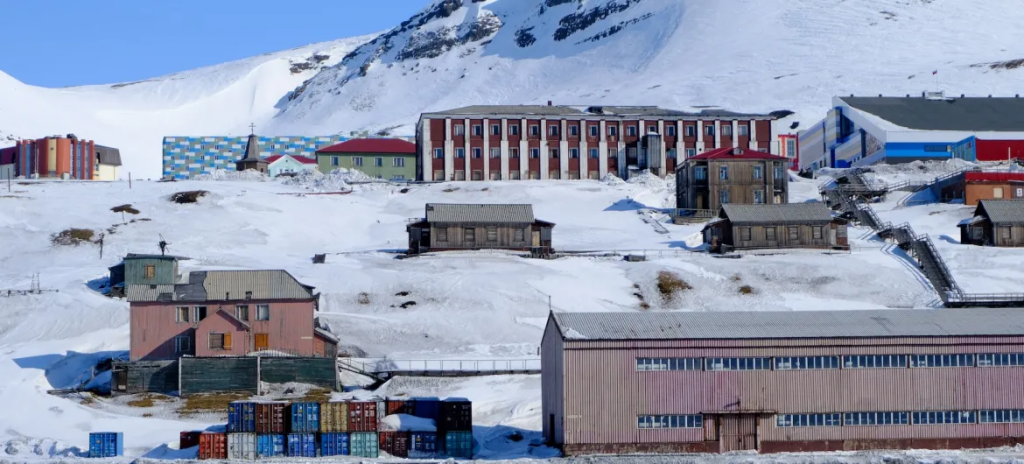
Our guided tour of Barentsburg was remarkably free of brazen propaganda – but also any mention of politics, let alone the war in Ukraine. The town was replete with a quirky combination of Dutch and Finnish wooden houses and concrete Soviet apartment blocks painted in primary colors. The number of structures seemed to exceed the town’s population. In front of one hulking building, under a series of Russian tricolors flapping in the wind, a stone engraving proclaimed, “OUR GOAL – COMMUNISM,” as if the Soviet Union had never collapsed.
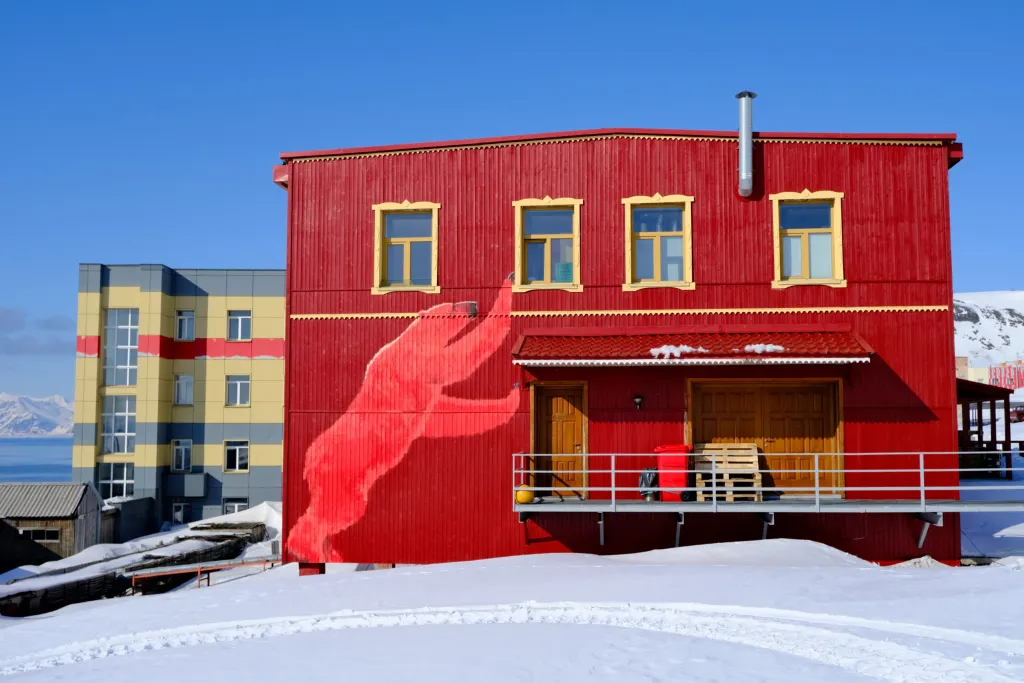
Some of the timber buildings bore murals. One depicted trees, making for quite the mirage in the barren High Arctic, while another spelled out a haunting few lines from a 1965 poem called “Arctic Illness” by Robert Rozhdestvensky. Street signs in English pointed tourists in the right direction, whether towards the post office or husky kennel.
We walked by the Russian Consulate General, which Katya explained is “supposedly gorgeous inside,” though she’s never visited. “You have to be invited to go there. Maybe I’ll go if there’s a wedding,” she knowingly smiled. There have been three ceremonies since she arrived a couple of years ago – further proof, perhaps, that love must be in the coal-choked air.
We next paused in front of a church built in 1998 after the devastating crash in 1996 of a Vnukovo Airlines flight from Moscow to Longyearbyen, which killed all 141 passengers on board. Most were Russian and Ukrainian workers who lived in Pyramiden, which closed two years later in no small part due to the disaster.
There was little in the way of peace and quiet for reflecting, however, because big Volvo bulldozers driven by burly Russians were constantly rumbling by as they shoveled snow off the streets to the end of town before dumping it off a cliff. A surprising amount of powder had fallen that winter – enough to let me snowmobile all the way from Longyearbyen to the Isfjord Radio Hotel in May, which was unusually late in the season.

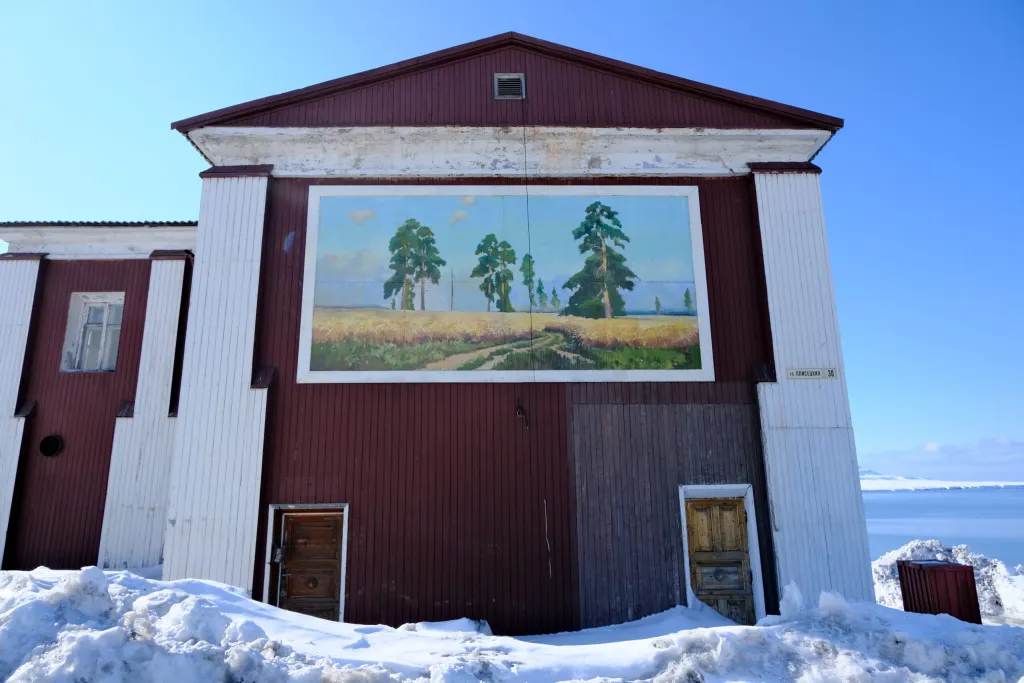
We strolled down the street past the town’s school, which was in session. Colorful murals portrayed a mix of Russian and Norwegian icons like onion domes and stave churches, while a menagerie of polar bears, orcas, and walruses were painted below. The faded friendship façade certainly dated from a pre-war time. Interestingly, however, other murals, such as that of the Russian poet, had been restored in recent years.
A few doors down from the school was a hotel originally intended to be a Hilton, or so the story goes. “Well, something happened,” Katya obliquely offered. “It’s still called that by locals, though.” We poked our heads inside and a few people in the tour group ordered drinks.
A French filmmaker from ARTE, a European public service channel, who had been onboard our cruise from Longyearbyen, checked into the hotel. He planned to stay for a week to film the upcoming Victory Day parade on May 9. Much to the chagrin of the Norwegian authorities, the celebration has become more militarized in recent years, featuring helicopters and snowmobiles driven by men in fatigues. (The ARTE documentary was released last August and is available online).
Across the street from the would-be Hilton was a Russian bar with red bear, not yet open for the day. Outside the wooden building was a metal sculpture commemorating the world’s northernmost internet radio broadcast, which was carried out using a mobile studio schlepped all the way from Moscow on February 7, 2020 – just a month before Covid shut everything down. While polar exploration on land and at sea may have peaked, new records are still being charted in the electromagnetic spectrum.
A ways down the road from Barentsburg’s high street, black smoke belched into the air from the coal mine. It’s supposedly the only such facility in the world that can be toured. Since the active layer now sits far below sea level, it takes miners, who work nine-hour shifts, 90 minutes to reach it. (German broadcaster DW has a Russian-language video on YouTube about the mine.)

Inside Barentsburg’s canteen and sports center
After the tour, we were given an hour to walk around by ourselves. While others made a beeline for the gift shop, I headed in the opposite direction for a slightly closer look at the mine before striding to the tourist office. My entrance was all but ignored by the dour Russian women working in the office. This gave me the leeway to gawk at a Russian map on the wall of Svalbard, which is called Spitsbergen in Russian. I suppose using the archipelago’s original Dutch name is easier for Russians to countenance than the Norwegian one. I nabbed some brochures and left.
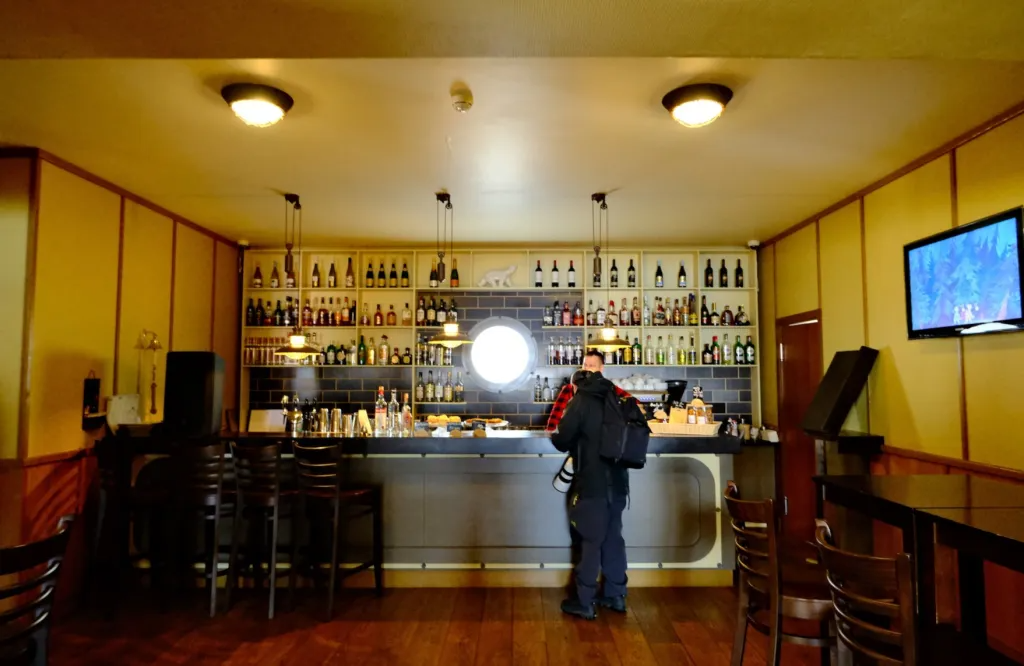
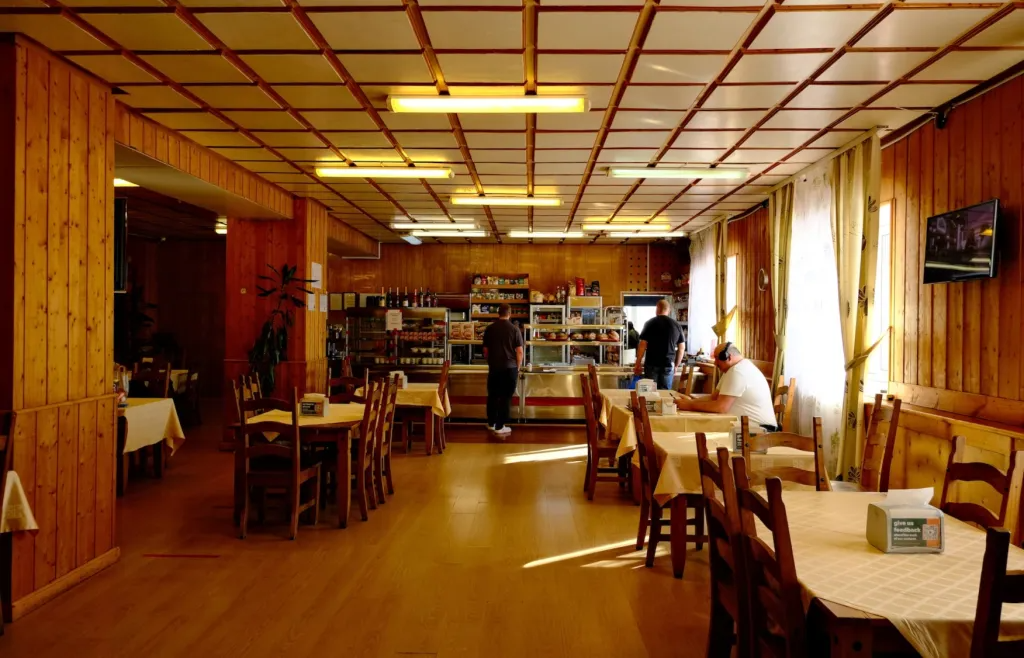
Next, I ventured inside the stolovaya, the town’s sole canteen. The moment I opened the door, a cloud of boiled cabbage and buckwheat rushed out to greet me. A few coats hung artfully in front of colorful Soviet-era murals. Inside, I took a photo of the canteen’s interior, seemingly unchanged since Soviet times. Several boxes of imported British cereal boxes had been placed on top of the counter like luxury items – which I guess, given the double whammy of remoteness and sanctions, they were. One of the cereal boxes was of Cini-Minis, a brand that I have now just learned was discontinued in 2018. This answers the question of how they avoided sanctions while raising a new one of why they were still for sale.
Getting food into Barentsburg has become trickier since Russia’s full-scale invasion of Ukraine, which prompted Norway to close its land borders and seaports to Russian ships. Previously, ships sailed directly from Murmansk to the Russian outpost. Since 2022, however, goods have been driven to the Russia-Norway border, picked up by Norwegian cargo operators, and then shipped from Tromsø. Despite these complex logistics, Barentsburg’s canteen operators have preserved the seamless uniformity of Russian cuisine. From Kaliningrad to Vladivostok to 78°N, the same microwaved miasma hangs in the air. In a decidedly un-Soviet twist, however, little napkin holders on the tables in Barentsburg asked in English for feedback “about the work of our canteen.”
As I moved closer to the counter to try to photograph the cereal boxes, a bear of a man doffed his noise-cancelling headphones and addressed me in a nearly flawless American accent: “It’s very nice that you’re taking pictures, but it would also be nice if you would ask. It has something to do with respect.”

Tail between my legs, I apologized and headed back out into the unpickled air. I stumbled past the world’s second-northernmost Lenin statue, trying to stay upright on the same slippery sidewalks that two teenage boys were gracefully gliding down. At the bottom of the road was a modern sports and culture center housing a library with 30,000 books and a pool, which cost 150 Norwegian kroner (NOK) (~US$15) to enter.
Officially, NOK is the only currency allowed in Barentsburg because it is located within sovereign Norwegian territory. To get around this, Trust Arktikugol, the state-owned coal company that runs the Russian outpost, pays its employees with a mix of NOK and “Spitzcoin,” which is tied to the Russian ruble and loaded onto a plastic card. The pretend currency reminded me of the plastic coins used in Transnistria, a Russian breakaway republic in Moldova. Whether it’s crypto or plastic, Russia seems to always find a way to circumvent financial restrictions.
Outside the sports center, a young girl waited with her inner tube in a bag. Pools are a huge draw in Arctic settlements since they offer a year-round, family-friendly amenity that can operate rain, snow, or shine. On the other side of the Arctic Ocean in Tuktoyaktuk, a small hamlet in Canada’s Northwest Territories, someone once told me that they wanted a year-round road built south across the tundra to Inuvik, a larger town 150 kilometers to the south, just so that they could take their kid to its outstanding pool. Having been humbled in the canteen, I asked the young Russian girl waiting to enter the sports facility if I could take her photo. She cheerfully agreed.


Soon after, it was time to hurry back onto the boat. If I missed it, I would have had to check into the “Hilton” for a couple of nights until vessel’s return. That wouldn’t have been the worst outcome in the world. Maybe I would have had a cameo in that ARTE documentary, similar to how I’d ended up on the Norwegian news while checking out the protest in Longyearbyen against Mark Zuckerberg and his superyacht. I would have also gained a bit more time to experience Barentsburg, which, along with Pyramiden, is one of the rare places where a Westerner can still glimpse the Russian Arctic. And who knows: maybe I would have met someone in the canteen, been upgraded from a hotel room to a proper flat, and eventually gotten to see the inside of the Consulate General.
There are ethical reasons for Westerners to avoid Barentsburg, let alone an extended stay. Visiting supports the state-owned coal company and therefore subsidizes Russia’s war effort. While I refrained from spending any money in town, the cruise operator, Henningsen Transport, pays a docking fee to Trust Arktikugol. But for those interested in seeing firsthand what life is like on the other side of the curtain, the trip may be justifiable.
Moreover, halting all forms of trade with Russia has proven nearly impossible. In the first half of 2026, for instance, Europe, bought almost all of the liquefied natural gas (LNG) produced by Yamal LNG, the Russian Arctic facility that produces five percent of the world’s supplies. At least spending money in Barentsburg offers the benefit of people-to-people exchange.
As we sailed out of the Green Fjord, we passed the Barentsburg Heliport. I tried to zoom in with my camera but couldn’t notice any activity, suspicious or otherwise. For what it’s worth, I thought the activity in town was far more eye-opening. Beneath headlines filled with submarines and spies, here were little glimpses of daily life, where swimming pools and cereal boxes were top of mind.
Russia’s ambassador to Norway gets protective about Svalbard
For Russian officials, life on Svalbard is inseparable from geopolitics. In an interview with CNN in July 2026, the Ambassador of Russia to Norway, Nikolay Korchunov, underscored that Russia’s interaction “with the Norwegian side on Spitsbergen is pragmatic in character and is aimed at protecting the rights and interests of Russian citizens residing in the archipelago, ensuring the operation of the Trust Arcticugol, and the work of Russian scientific organizations.”
Korchunov’s description of the “Norwegian side” is a hot take considering that Norway sees only one side to the archipelago: its own. The ambassador also indirectly expressed a worry that, encouraged by Croatian President Zoran Milanović, Trump might soon start shifting his attention from Greenland to Svalbard.
Arctic islands are sometimes places where the world comes together, whether in the form of a Norwegian-Russian post office or multilingual classroom in Longyearbyen. But they are also sometimes places where the icy seams of the world start to show.

…So, wherever you may wander now,
on the threshold of any spring,
you will rave about polar routes,
you will see snowy dreams.”
Excerpt from Arctic Illness, poem by Robert Rozhdestvensky (1965)
Related stories from around the North:
Canada: A rhino in the Arctic? Nunavut fossil discovery gives new insights into mammal evolution, CBC News
Greenland: New Greenland fossil discovery unveils ancient tundra, clues to sea level rise, Eye on the Arctic
Norway: Sharp population decline in Barentsburg in Norway’s Arctic archipelago, The Independent Barents Observer
Russia: Except for military towns, Russian North sees sharp decline in population, The Independent Barents Observer
United States: Archaeological site in Alaska that casts light on early Yup’ik life ravaged by ex-Typhoon Halong, The Associated Press