The Liberal government’s new national security strategy stresses the need to better manage shocks to Canada’s economy while fostering growth and innovation to make the country more resilient.
The long-awaited strategy, made public Thursday, flags the dangers of traditional threats – such as espionage and foreign interference – as well as challenges emerging from great power rivalries, authoritarian aggression, the rapid evolution of artificial intelligence and the perils of climate change and pandemics.
The strategy says Canada can achieve greater strategic independence through a secure and growing economy, a disciplined foreign policy, a stronger and more agile military and better intelligence efforts.
“These will allow us to withstand shocks, adapt to the unexpected, make our own choices and thrive in the decades ahead,” the document says.
It says securing Canada’s sovereignty in key industrial sectors – and delivering resources and expertise to the world – will reinforce the country’s position as a strategically important player in the global economy.
The overarching framework, called The Plan for a Stronger Canada, will be followed by a series of more detailed plans, including a new foreign policy to be made public in about a month.
Policies on defence, public safety, economic security and intelligence will roll out over the coming months.
Ottawa says it will convene a first ministers meeting on national security, likely next year, to strengthen co-ordination among federal, provincial and territorial governments.
The government also promises to bring forward proposals to modernize national security legislation within the next year. Officials provided no specifics about what that might entail during a briefing Thursday.
“Canadians should expect more frequent updates to Canada’s national security legislative framework to adapt to the pace of new threats and protect our common values,” the strategy says.
The government also says it plans to initiate a review of the “entire national security enterprise” to inform the first update to the overall strategy in no more than four years.
The last comprehensive national security policy was published in 2004 by the Liberal government of Paul Martin.
In a message included in the new strategy, Prime Minister Mark Carney says today’s world demands a plan that reflects profound realities.
“Canada stands at a hinge moment in history,” Carney writes.
“The world is increasingly defined by contested borders, authoritarian aggression and acute global threats. The long-held belief that the combination of our geography, interconnectedness and a rules-based international order could substitute for Canadian sovereign capacity to protect ourselves is no longer tenable.
“The international rules-based order is under threat. The open global trading system is deeply challenged. What were once strengths – our strong connections and deep integration with other countries – have become vulnerabilities.”
Canadian energy, critical minerals, advanced manufacturing and leading technologies “will be the bedrock of our relationships” that promote a sovereign Canada and contribute to a more secure and prosperous world, Carney writes.
The strategy cites a need to be transparent and engage Canadians on the seriousness of the threats and the need for effective responses, and to prepare for “all contingencies up to and including war and other worst-case scenarios.”
On foreign policy, Ottawa plans to diversify Canada’s trade relationships while protecting national and economic security, including communities vulnerable to transnational repression.
It also wants to retool Canadian diplomacy to more effectively help companies expand abroad, secure supply chains and grow exports.
Strengthening partnerships in the Arctic
The strategy cites a desire to build a “co-operative, clear-eyed relationship with the United States” based on mutual respect, national sovereignty and shared responsibility for the security of North America.
The government also plans to give Canada a broader, deeper range of military options to deter and defend against hybrid warfare and threats in space and cyberspace.
It says it wants Canada to be a defence partner of choice by meeting its commitments to Norad and NATO, strengthening partnerships in the Arctic and demonstrating its ability to contribute to security and stability in the Indo-Pacific, the Middle East and elsewhere.
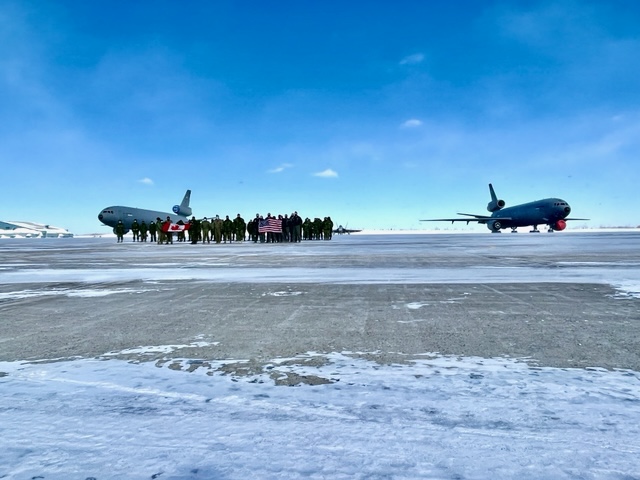
The strategy also flags Canada’s plan to boost its intelligence capabilities, collection and analysis, expand its contributions to the Five Eyes intelligence partnership and diversify intelligence partnerships elsewhere.
Ottawa promises to strengthen the capabilities of the Canadian Security Intelligence Service, defence intelligence and the Communications Security Establishment, Canada’s cyberspy service.
Officials also indicated the government will assess the strengths and weaknesses of Canada’s security and intelligence community before deciding on changes, such as an expansion of foreign intelligence gathering capabilities.
Related stories from around the North: :
Canada: Arctic cooperation on agenda as Canada, EU leaders meet at Montreal summit, Eye on the Arctic
Denmark: Denmark, Greenland agree to build naval wharf in Nuuk amid growing Arctic focus, Eye on the Arctic
Finland: Leaders of Norway and Finland call Putin in break with previous European stance, Reuters
Iceland: Europe’s Von der Leyen strengthens Arctic security ties with Iceland during visit, Eye on the Arctic
Norway: Naftogaz targets Russian properties in Oslo after Svalbard move, The Independent Barents Observer
Russia: On eve crushing new EU sanctions, Moscow ratifies LNG deal with Beijing, The Independent Barents Observer
United States: U.S. Coast Guard monitors Chinese ships in Arctic waters…again, Eye on the Arctic