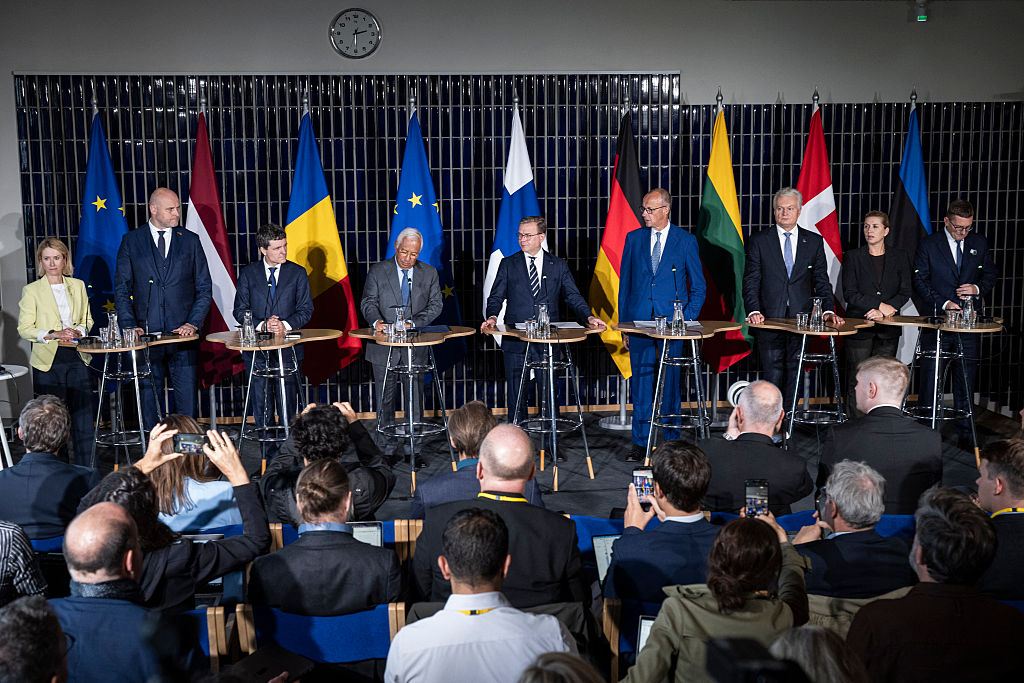
Russia poses a long-term threat to European security that requires greater cooperation and investment in the Arctic, 12 European Union countries said in a joint declaration Monday.
“We note with serious concern the significant and long-term threat Russia poses to Euro-Atlantic security,” the declaration said.
“Russia’s ambitions to increase its influence in the Arctic, combined with its hostility towards Europe, including the increase in hybrid activities highlight the need to strengthen the EU’s Arctic policy.”
The statement from Finland, Denmark, Estonia, France, Greece, Germany, Latvia, Lithuania, the Netherlands, Poland, Romania and Sweden followed a two-day European Arctic Summit hosted by Finland.
Russia’s war in Ukraine, China’s growing security interest in the region and the accelerating effects of climate change are reshaping the Arctic, requiring the EU to take a more proactive role, the countries said.
Closer coordination between the EU and NATO, investment in cirtical minerals and space technology like satellites were some of the key areas to be developed, they said.
Joint EU icebreaker ownership?
The possibility of jointly procuring and owning icebreakers was also discussed at the meeting.
“Considering the geopolitical situation that we are in and considering climate change and opening of the maritime routes, we need more icebreakers or ships that are able to navigate in these difficult situations.” EU foreign policy chief Kaja Kallas said at a press conference broadcast after the summit.
German Chancellor Friedrich Merz said Berlin supported the idea, saying the ability to operate in the High North was no longer just a concern for Arctic nations.
“This is not just an issue for Finland, for Norway for Sweden, this is something for the entire European Union, for the European continent,” Merz said at the press conference.
The European Arctic Summit declaration comes ahead of an updated EU Arctic policy expected later this fall.
Comments, tips or story ideas? Contact Eilís at eilis.quinn(at)cbc.ca
Related stories from around the North:
Canada: Canada joins NATO allies for Arctic Shield exercise in Greenland, Eye on the Arctic
Denmark: Denmark to expand Arctic surveillance with purchase of long-range drones, Eye on the Arctic
Finland: Finland completes 200km of fence along Russia border; 25 km stretch across Kainuu into Lapland, The Independent Barents Observer
Greenland: EU pledges €200M to Greenland hours before Trump posts map of island under U.S. flag, Eye on the Arctic
Iceland: Iceland to seek new security partnerships after voters reject EU accession talks, Eye on the Arctic
Norway: Norway’s ambassador summoned to Moscow foreign ministry as wave of propaganda hits the headlines, The Independent Barents Observer
Russia: Russia’s hybrid attacks in focus as European leaders meet in Finnish Lapland, Yle News
Sweden: British, Swedish and American reconnaissance aircraft monitor Russia’s Kola Peninsula, The Independent Barents Observer
United States: White House releases U.S. Arctic strategy implementation plan, Eye on the Arctic