by Carl Johnson, Owner Alaska Photo Treks
Travel to see the aurora borealis has taken off considerably with the advent of digital photography and the explosion of information (and misinformation) available on social media. While there are plenty of blogs and articles telling you about the science of the aurora, how to photograph the aurora, or where to go to see it at specific locations, very few offer good information on how to plan and execute a successful aurora borealis vacation. So we thought we would put this together for you!
1. Give Yourself Time
One of the common mistakes people make is to give themselves only one night to chase the aurora borealis, despite it being one of their “bucket list” items. In particular, we will have people book our Anchorage Aurora Quest or Private Aurora Tour on their last night in Alaska, giving themselves no room in their schedule to try again if the weather does not cooperate on that particular night.
If you are coming to Alaska to see the aurora borealis, we recommend giving yourself a minimum of seven nights, and splitting your time between Anchorage and Fairbanks. While Fairbanks markets itself as the destination to see the northern lights in Alaska, it’s just not the case. Tour professionals in Fairbanks used to say that a three-night stay, and chasing the aurora each night, would give you a 90% chance of seeing the northern lights. Now, they indicate it is more like five nights. With climate change progressing, Fairbanks is seeing more cloudy nights in the off-summer months compared to before. In September 2024, one tour operator cancelled their tour about 50% of the nights booked due to cloudy conditions – the same ratio we had down in Anchorage. And with our northern lights tour, we have had several guests tell us that they tried unsuccessfully to see the northern lights in Iceland and Fairbanks, only to see them for the first time on our Anchorage-based tours.
In addition to staying at least seven nights, you need to be prepared to be available to chase the aurora borealis – whether alone or on a tour – on every night. You also need to be prepared to be out late, as the aurora will peak at around solar midnight. Solar midnight is the exact time when the sun is at its lowest point in the sky, precisely opposite to your location on Earth. This term is used to describe the moment when the sun is at its farthest below the horizon, making it the darkest and typically the coldest part of the night. it is not necessarily the same time as local midnight. For the Anchorage area, this is typically around 12:30-1:00 a.m. on a normal night.
2. Think Carefully about When to Travel
There are several factors that affect aurora viewing, so you want to travel at a time when the factors are most in your favor. Every single component will increase, or decrease, your odds of seeing the aurora borealis.
Moon Phase. The moon will affect aurora viewing. The brighter the moon, the more it acts like light pollution. From data we have collected over the years, we have split up the moon phase into three areas. Moon illumination below 40% will not affect viewing a quiet aurora display. From 40-75%, it might affect viewing a quiet aurora, but not completely prevent it. Any moon illumination over 75% will completely block viewing a quiet aurora display. But active displays are still visible, even under 100% moon illumination. For good landscape photography, a moon illumination of around 40-50% is ideal, to allow your camera to capture details in the landscape. So look at the moon phase at the time of the month when you are thinking of traveling – and remember that a moon illumination of 40% or less provides the best chance of viewing the aurora at all levels of activity.
Cloud Cover. Lastly, cloud cover will affect aurora viewing. Clear skies or mostly clear skies (10-30% cloud coverage) will not affect aurora viewing. In fact, sometimes clouds add interesting elements to aurora photos. But the cloudier it gets, the more aurora viewing may be affected. Certain types of clouds, like high altitude clouds, may still allow for aurora viewing. Generally speaking, if you can see the stars, you can see the aurora. A complicating factor is the moon. As it gets brighter, it also lights up those clouds like a soft box for a portrait studio strobe. Again, when deciding when to go, look at which month has the lowest percentage of cloud cover over all at that location.
Time of Year. There are two layers that indicate the best time of year to travel to see the aurora borealis. First, you need to know the amount of darkness at your planned location at the time of year you intend to travel. For much of Alaska, the aurora is not visible in June and July because it is not dark enough at night. Don’t think you can see the aurora during your land cruise to Fairbanks in July after getting off the cruise ship. When looking at sunrise and sunset information, you want to target a time period when the location has at least a few hours of astronomical twilight – the minimum darkness necessary to see any level of aurora display.
Second, you need to know when the aurora is at peak activity. The aurora is most active around the fall and spring equinox. Cracks occur more frequently in the Earth’s magnetosphere during those times, allowing the sun’s charged particles to enter our atmosphere to produce active aurora displays. When reviewing two factors – average daily Kp index and average number of geomagnetic storms in the month, you get a view of when the best months are to see the aurora borealis. This does not mean the aurora borealis is not visible in the quieter months – we have some Decembers with a 100% success rate of seeing the aurora.


Now you are going to hear a lot of talk about Solar Maximum, and how the aurora will start becoming more rare as we progress toward Solar Minimum. (It is common click-bait during this time of the solar cycle, now that we are currently at Solar Maximum.) That’s not entirely accurate. Solar Maximum measures, in part, the frequency of sun spot activity. Peak sun spot activity occurs around Solar Maximum. It is sun spots that produce solar flares that fling off a Coronal Mass Ejection (CME) into space. And CMEs do have a tendency to produce geomagnetic storms. However, as we head toward Solar Minimum and sun spots become less frequent, coronal holes become more frequent. And those can produce coronal hole high speed streams, which can also produce visible, active aurora displays.
3. Where to Go
This is of course the big decision: where do you want to visit? An easy rule of thumb is that the farther north you go, the better. It is probably best to not try a Kansas-based aurora vacation, no matter how good their barbecue is. Any location that lies directly under the Aurora Oval is the best. In Alaska, that is the area of Coldfoot and Wiseman in the Brooks Range. As the aurora gets more active, that oval expands and moves southward. On many nights, Anchorage is within the aurora oval. Related to that is something called the Aurora Ovation, which is a model showing the likelihood of seeing the aurora on a particular night.
Think about the specific region of the destination you are considering. What is the scenery like? What type of weather do they have at the time of year you are going? How easy is it to travel independently?
Lastly, think about what else there is to do while you are visiting. Unless you are out chasing the aurora all night every night, you may want to do something during the daytime. What sort of activities are available? In September in the Anchorage area, you can still do summer things like glacier cruises and brown bear viewing. In the winter, there is the opportunity to go dog mushing, snowmobiling, ice fishing, skiing. In late February in Anchorage, we have our Fur Rondy winter festival, plus the ceremonial start of the Iditarod on the first Saturday in March. In February and March, Fairbanks hosts the World Ice Art Championship. Then in April, we have migratory birds in the Anchorage area as well as the full resumption of glacier cruises in Prince William Sound.
4. Be Prepared for Cold
Quite often, our guests are not prepared for how cold the temperatures are during our tours. While we provide that information in advance, seeing numbers on a page does not equate the in-field experience. We provide parkas, blankets, and hand and toe warmers, but for some people, it does not overcome their aversion to cold or their thin layers. Being comfortable in colder conditions is a key factor to really enjoying the aurora-chasing experience. The people who stay outside of a warm vehicle or warm room longer have a better chance of seeing the aurora borealis and generally having a fun time.
When I am driving, I am wearing fewer layers and basic shoes. But when gearing up for being outside, I go to specific gear to be ready for extended periods away from the warmth of my car. From head to toe, you will not see me wearing cotton. It has to be either synthetic or wool or fur, for the simple reason that cotton, when wet, takes longer to dry and does not retain heat as well. My head is covered with wool or fur. I wear a down parka over my body. I will wear at least two layers underneath that. For my hands, I use the Heat 3 Smart Gloves by the Heat Company. On my feet, a pair of wool socks and a set of Cabela’s Trans-Alaska boots.
5. Manage your own Expectations
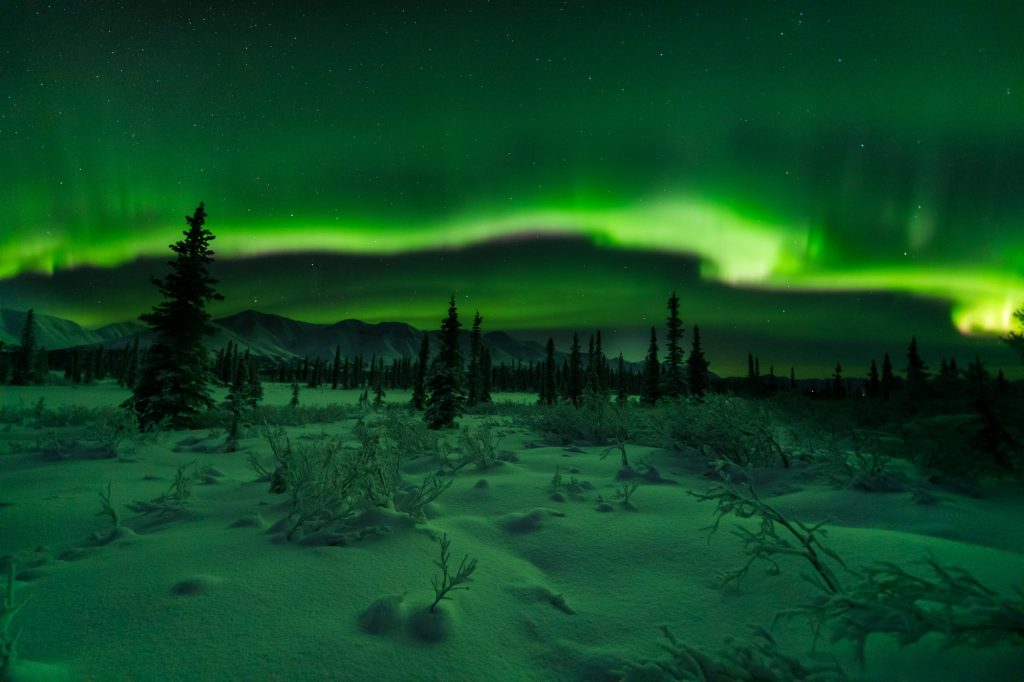
Social media has been great for expanding interest for northern lights viewing, but it has also been a curse. Based on what people see on social media, they tend to think that the aurora borealis always looks like this:

This is what the aurora looks like during a geomagnetic storm. But statistically, even during the best month (March), there is only a 1-in-3 chance of seeing an aurora display ignited by a geomagnetic storm. More often, the aurora will be quiet to unsettled (Kp0-3), which will look more like this on a good night after it gets a little active:

Another part of expectations is what people expect to see in color. While it is true that the color most commonly seen is green, it is not the only color. (Read more about what causes the colors in the aurora borealis.) An active geomagnetic storm can produce green, pink, red, purple and blue. Blue is the rarest of all colors.
But here’s the key: while many of these colors may be visible to a camera and show up in a photo, they are often not visible to the naked eye. Only a powerful, bright geomagnetic storm will produce colors other than green that are visible to the naked eye. I can count on one hand the number of times I have seen red with the naked eye. The cones in our eyes that transmit color to the brain don’t work well at night. A long exposure of a camera overcomes that problem. This is how the camera will see the color.
The key takeaway is that you expect to see a lot of color with the naked eye, or really active, sky-filling aurora all the time, you set yourself up for disappointment.
6. Consider Aurora Chasing a New Travel Objective
You will quite often hear people refer to seeing the aurora borealis as a “bucket list” item. With many of those people, once they check an item off the list, they are done. Aurora chasing can be so much more fulfilling than that. Just like people travel to different regions or countries for food or wine, the same can be true for the aurora borealis.
Even though I live in Alaska and can see the northern lights as often as I want, I still enjoy traveling to other locations to see the northern lights. I have photographed them in Canada, Iceland, Norway, and Sweden. Different locations provide different experiences, different cultures, different scenery, and a chance to do something new.
Also, consider getting into photography as part of the aurora chasing experience. As noted earlier, cameras can pick up colors more readily than our naked eye, so taking pictures always adds more to the viewing experience.
Always remember that aurora chasing is a marathon, not a sprint. Once you get a great aurora experience, you will want to do it again and again. And now you will have one more reason to travel and experience new locations.