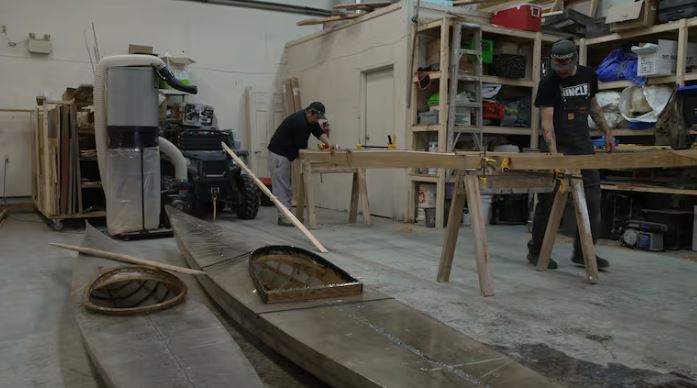

Inside a workshop in Iqaluit, Izaac Wilman shows off his decade-old wood furnished qajaq, or Inuit kayak, made in the West Greenland style.
“There’s a lot of material on the West Greenland one, so it’s an easy one to start with,” he said.
Inuit hunters invented qajaqs to more easily harvest seals and whales on the water, and they were ingeniously constructed using only materials on hand.
Wilman teaches Iqaluimmiut how to build those vessels as part of the Qajakkut Society, which was established in 2016 to revive the art.
Robert Comeau, a fellow qajaq maker, said he and Wilman were first exposed to the practice by some polar adventurers.
Since then, they have taught themselves how to build qajaqs more and more.
It’s not just the West Greenland style they had on display at an open house in July.
“Everything has different dialects and different regions,” Comeau said, “so it’s really cool as we progress through our journey as qajaq builders to use the skills we’ve developed to bring the south Baffin qajaq back into view.”
By learning and celebrating those differences, Comeau hopes the tradition will become commonplace once again.
A C-130 fighter jet vs. a Hercules
Even with a quick glance, it’s evident there’s a difference between the two qajaqs.
The South Baffin qajaq, Comeau explains, is one of the largest across Inuit Nunaat and designed to withstand the large tides in the region and carry more seals.
“The Greenland style, I call it like a fighter jet, and our [South Baffin] style is kind of like a C-130 Hercules,” he said.

The South Baffin style also sports a narrower, d-shaped rim, which Wilman believes helps hunters easily slide their rifle into the qajaq — one of many differences in traits that he is fascinated by.
The two men travel across Nunavut to showcase their work, and many Nunavummiut have a story to share about the qajaq.
“We get people coming up to us saying, ‘oh, I remember my grandfather had one,’ or, ‘I remember my father had one,’ or, ‘I remember riding inside of one and falling asleep to the sound of the noise,’” Comeau said.

Spreading knowledge far and wide
Hearing those stories reminds Comeau of who he is and how Inuit survived — but he doesn’t want it just relegated to the past.
Right now, Comeau said it takes a lot of investment to get the necessary materials and space to construct qajaqs.
As much as he enjoys teaching the art, he said he wants to spread that knowledge far and wide so that it might become a part of everyday life once again.
“I would love to see where fathers are teaching their sons again, and mothers are teaching their daughters,” he said.
Related stories from around the North:
Canada: Conservation an important path forward for Nunavut’s economy, says report, Eye on the Arctic
Finland: Conservationists find more critically endangered Arctic fox cubs in Finnish Lapland, Yle News
United States: Alaska museum’s latest exhibit gives unique look at pingoes, Alaska Public Media
Greenland: Canada and Greenland sign letter of intent on marine conservation area in Arctic, Eye on the Arctic
Norway: Climate change hits back at Svalbard, coal mine flooded by melting glacier in Norway, The Independent Barents Observer