
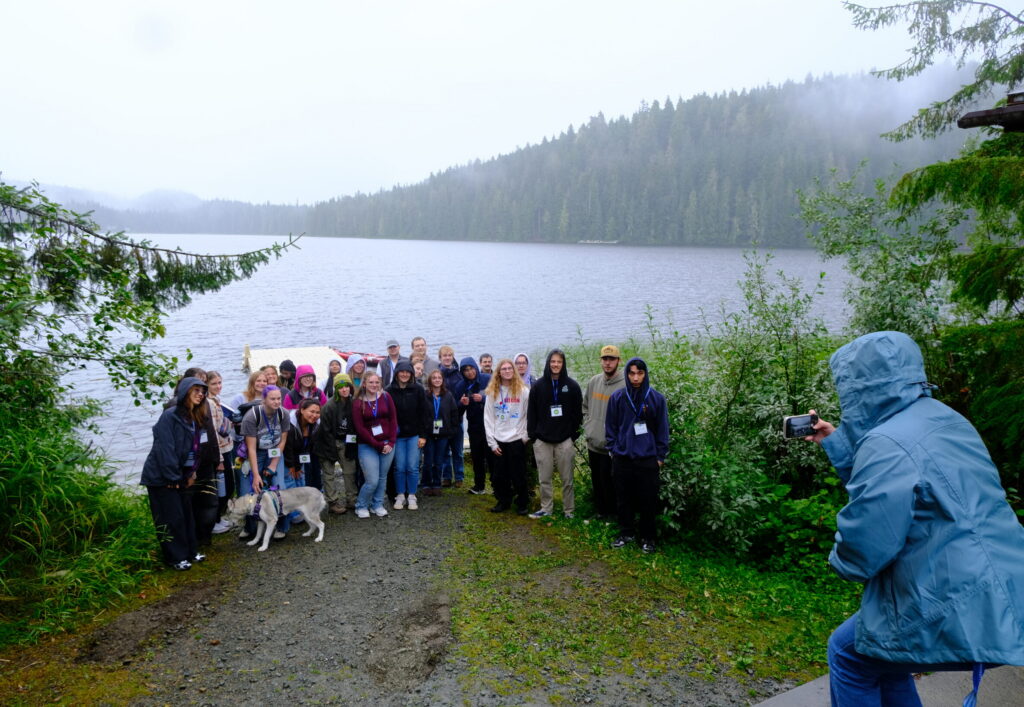
Under a driving Juneau rain, dozens of new students at the University of Alaska Southeast gathered Friday for orientation and to kick off the fall semester. This year, the public university saw a boost in enrollment of out-of-state students, which officials and students say is largely due to a new policy eliminating the non-resident tuition rate.
UAS piloted the new tuition policy this year, called Alaska Unlocked, which offers the standard in-state tuition rate for all undergraduate courses, regardless of the student’s residency.
That’s resulted in an estimated 36% increase this year in out-of-state students enrolling at UAS compared to last year, according to university officials.

“We are so thrilled with that much of an increase,” said UAS Chancellor Aparna Palmer, in an interview after her welcoming remarks to students at the Egan Library. “We know that a high percentage of our graduates stay in Alaska and work in Alaska within one year of graduation. And so most of these students are our future Alaskans.”
New students have arrived from 28 states, according to university data, with the top home states including Washington, California, Colorado, Idaho, Minnesota and Wisconsin.
The in-state tuition rate was a draw for 22-year-old Nicole Wilson of Phoenix, Arizona. After classes at community college, she enrolled at UAS to pursue a bachelor’s degree in marine biology with a focus on mammals. “I decided to come here both based on the in-state tuition and also because it was such, like, an ‘open to marine biology’ type school. My original plan was to go out to Hawaii, but it’s extremely expensive from out of state,” she said.
Wilson said housing was also a factor. “I did the math. If I were to take a dorm, which I would have had to, at any of the major universities in Arizona, it was actually more expensive than coming out to Alaska,” she said.
Cost of housing was the main consideration for 20-year-old Owen Kellon of Portland, Oregon, who is pursuing a bachelor’s degree in environmental sciences. “It was the bigger concern when it came to the cost of schooling, just because tuition was like a couple hundred bucks per class, which is perfectly reasonable. It’s about how much I was paying back at my community college in Portland, but the housing cost was the biggest factor.”

The standard in-state tuition rate is expected to be available across the University of Alaska system next year. Earlier this month, the UA Board of Regents moved to eliminate out-of-state tuition rates for all locations and degree types, aiming to draw more students to Alaska.
Currently, out-of-state tuition is double to quadruple the amount of resident tuition, depending on degree type. The Board of Regents is expected to take up a final vote on the policy change in November.
UAS has the smallest student population of Alaska’s public universities, with roughly 3,600 students last year across campuses in Juneau, Ketchikan and Sitka.
This year’s preliminary enrollment data shows roughly the same number of students as last year, signalling Alaskan student enrollment may have declined. But Palmer emphasized that it’s too soon to tell, as enrollment numbers are subject to change in the next few weeks with more Alaska students possibly signing up for dual enrollment programs or classes beginning later in the fall.

This year, UAS saw a 21% increase in applications from out-of-state students, and a 36% increase in newly enrolled out-of-state students. More than 80 new out-of-state students have enrolled this year, compared to 60 students last year, according to university officials.
UAS is an open access enrollment institution, Palmer noted. “What that means is, no matter where you are in life, whether you just graduated from high school, in high school, or whether you’re, you know, in your sixties or seventies, there is a way in which you can access UAS,” she said.
Most students are working adults or part-time students, Palmer said, and can enroll in classes in-person or online. “So, we do have a really diverse group of students,” she said.
In Juneau, new students had a jam-packed schedule for orientation week. On Friday, students were welcomed by UAS administrators, a Tlingit elder and student leaders, followed by a campus tour and briefings on campus resources, student clubs, tutoring, career counseling, and anti-discrimination and Title IX rights and reporting.
Students expressed excitement for the new school year and to be in Alaska, including Owen Kellon of Oregon.
“I love the rain,” he said. “ I am excited to see how the winter months will look like with only like six hours of sunlight. I’m scared, but I’m also excited.”

Correction: This story has been updated to correct the number of students enrolled at UAS, which was roughly 3,600 students last year.