
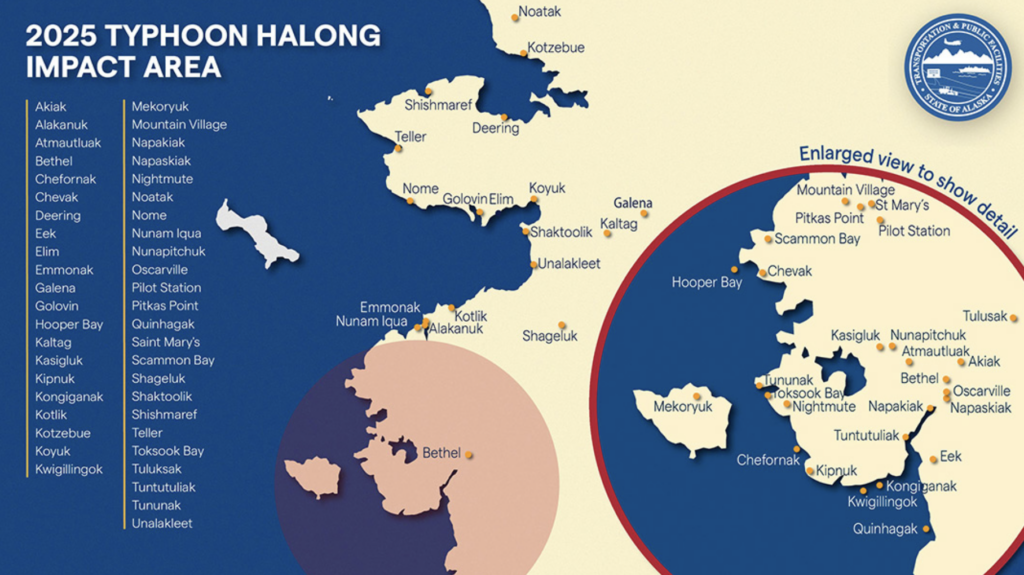
One year since the remnants of Typhoon Halong ripped through coastal communities of Western Alaska, displacing an estimated 1,600 residents and prompting the largest mass evacuation of the region in state history, the recovery effort is ongoing and uncertain.
Today there is no official tally of how many residents are still displaced from their homes. But nearly 200 households continue to receive federal temporary housing assistance, according to state officials.
Hurricane force winds and floodwaters damaged more than 45 communities, from Kotzebue down the coast to the hardest-hit Yukon-Kuskowkwim Delta region, the majority of whom are Alaska Native. Evacuated residents were displaced to the nearby hub of Bethel, or to Anchorage and other communities throughout Alaska.

Over the last year, local and state crews have made significant progress in repairing some homes and essential infrastructure in the region. That has included moving back more than 125 homes that were ripped off foundations — some floated miles away in the storm — according to officials with the Alaska Department of Transportation and Public Facilities.
Emergency infrastructure work is “mostly complete” in 30 communities, a DOT spokesperson said by email, including repairing critical community systems such as water, wastewater and power to restore basic functionality. But repairs, recovery and environmental and debris clean up is ongoing.
More than 2,500 people received some kind of federal assistance from the Federal Emergency Management Agency over the last year, with FEMA reporting over $100 million in aid spent on individual, household or other needs assistance.
In October of last year, Gov. Mike Dunleavy said the Trump administration would fully reimburse the state for the first 90 days of immediate disaster relief and recovery efforts. But when the state made that request it was denied, as well as an appeal for a 90-10 cost share with the state. That leaves FEMA covering 75% of disaster relief costs and the state covering 25%.
On the state side, legislators approved an additional $75 million for the state’s disaster relief fund last fiscal year, with nearly $28 million spent on the Halong response, according to officials with the state’s legislative finance division this week. More than 2,300 people applied for state disaster assistance, which covered additional repairs not covered by FEMA assistance such as damage to subsistence camps. The state has allocated $2.65 million in that state aid, but the number of people who received state assistance was not immediately available, according to Jeremy Zidek, public information officer with the Alaska Department of Homeland Security and Emergency Management.
Local and regional Tribal governments and organizations, municipalities and non-profits have also provided assistance and donations to storm affected residents and the recovery effort.
Funding for rebuilding homes uncertain
But repairing and rebuilding homes, which would allow displaced residents to return, is largely at a standstill — particularly in the hardest-hit communities of Kipnuk and Kwigillingok.
In August, FEMA denied Alaska’s request for permanent housing construction assistance. The state is planning an appeal, according to state officials.
State officials say Dunleavy was in Washington D.C. on Monday to meet with FEMA officials and urge their reconsideration of the agency’s denial of the housing funding. The funds would enable repairs and rebuilding of hundreds of homes, beyond the $44,800 per household in assistance provided by FEMA.
Dunleavy officials did not offer details about the trip or respond to a request for comment about broader recovery efforts on Monday.
Bryan Fisher, commissioner with the Alaska Department of Homeland Security and Emergency Management, told Alaska’s News Source that housing is a huge concern on the state level in an interview on Monday.
“There’s still not sufficient resources to rebuild and repair the homes that were either destroyed or catastrophically damaged,” he said.

Fisher said FEMA is estimating a cost of $200 million for the disaster recovery, but he has doubts. “I expect that to double. I think it’s going to be more around $400 million dollars when all’s said and done,” he said.
Rising costs of fuel and construction materials, combined with weather and logistical challenges to barge in supplies and remove storm debris presents ongoing challenges, he said.
For Kipnuk and Kwigillingok, tribal leadership have issued no-return orders for residents while repairs are ongoing. Both communities have also voted to relocate, with Kwigillingok voting to do so before Halong hit, with potential sites selected on higher ground, according to KYUK. But how and when funding and state and federal support would assist in relocation has yet to be determined.
“A huge cleanup effort still needs to be accomplished, and homes need to be rebuilt,” Fisher said. “The infrastructure is there, power and water is available, but there isn’t housing available for folks to return to. So until that happens, it’s really not safe or appropriate for folks to return to the communities.”
Fisher said there is only government support to stabilize and rebuild storm-damaged communities, not for permanent relocation.
“So the disaster recovery programs, both at the state and federal level, can’t facilitate the entire relocation of a community,” he said. “There is no one federal agency. There is no one source of funding.”
Fisher said the goal is to rebuild to allow people to return to their communities, their subsistence lifestyle and culture. “So our goal is to get them home as soon as we can,” he said. “And then work with them and all the partners necessary to look at long-term relocation and whole community relocation.”
Building back stronger
Fall storms have become more frequent in Western Alaska in recent years, and Fisher acknowledged the dilemma of building back in a region still at risk for future storm disasters.

“So we spend more money repairing damage caused from storms as opposed to saving money on the front end and looking at real mitigation,” he said. “So it’s a challenge, and we’ve had lots of conversations with many, many administrations about more funding for that — to be able to protect folks and have them not be impacted by storms.”
In the meantime, he said the state’s focus is on rebuilding. “Our commitment is to rebuild stronger, higher, more resilient, so the communities can survive future storms,” he added.
That involves additional engineering to stabilize structures, he said, fortifying homes and boardwalks against future storm surges and thawing permafrost, using steel helical pilings.
“Most of those boardwalks were destroyed during the storm, those that were installed with these pilings survived. So this winter, we made a huge effort to rebuild all of that boardwalk. You know, transportation through the communities is critical to facilitate the rebuilding, and we put all the new boardwalks on piling so they’ll be more survivable in the future.”
Officials with DOT reported that over the past year local and state crews installed more than 25,000 feet of boardwalk and 11,000 helical piles, and 19 million pounds of cargo transported as part of relief efforts.
Looking ahead, repair work is continuing and preparations for winter are underway, even as funding and prospects for many to return home are uncertain.
In a social media post on Monday, Republican U.S. Sen. Lisa Murkowski acknowledged the devastation of Halong and the uncertainty communities still face, and pledged to continue advocating for federal support. “I will continue working to improve disaster preparedness and recovery for communities across our state,” she said.
“One year later, we cannot look away. I remain committed to standing with affected communities, listening to their voices, and ensuring they have the opportunity to shape their path toward healing and long-term recovery.”