Alaskans who have been wrongfully convicted can now apply to claim Alaska Permanent Fund dividends that were withheld while they were incarcerated, under a new law.
The Alaska Legislature passed Senate Bill 167 by a combined vote of 58 to 2, and Gov. Mike Dunleavy allowed the bill to pass into law without his signature last month.
Under current Alaska law, those who are incarcerated or sentenced as a result of a felony or certain combination of misdemeanor convictions are ineligible for the Permanent Fund dividend. The amount equivalent to those dividends is deposited into a restorative justice fund each year.
Under the new law, past dividends will be granted to people whose convictions were vacated or reversed, or those who had charges against them dismissed. People who were found not guilty after their case was retried are also eligible. Individuals whose charges were dropped as part of a plea agreement in another criminal case would not be eligible.
Exonerees have two years after a dismissal or not guilty finding — or two years after the bill’s effective date — to apply for the past dividends through the Permanent Fund dividend office with the Alaska Department of Revenue. The bill is set to take effect on September 16.

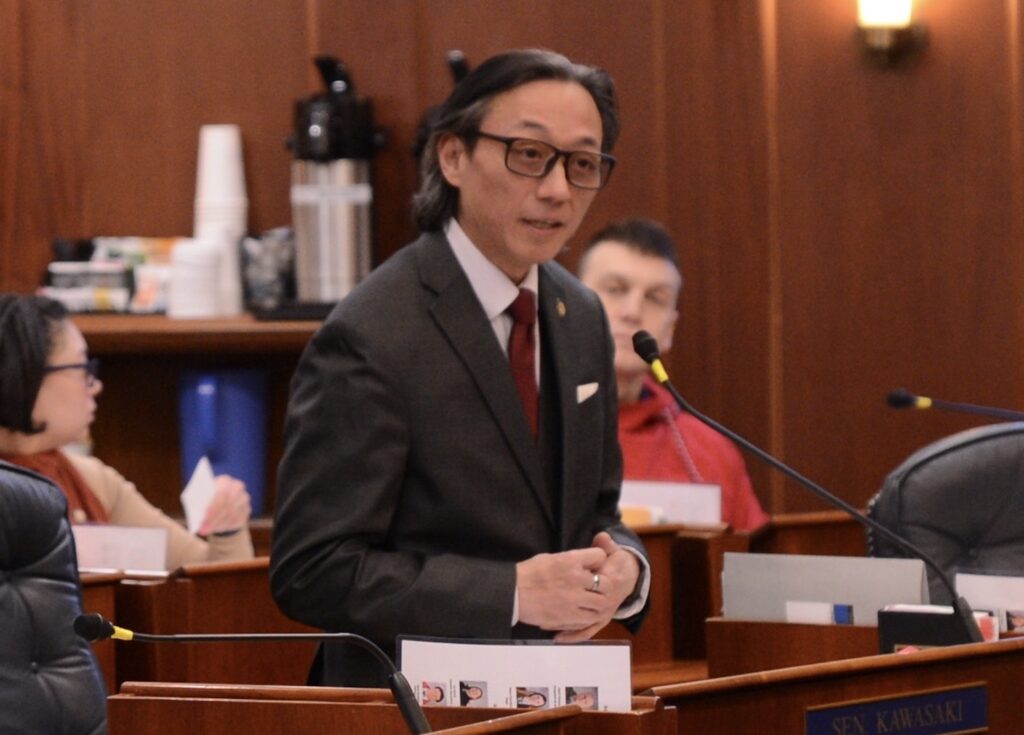
Sen. Scott Kawasaki, D-Fairbanks, sponsored the bill and told lawmakers at a May hearing that the state has a responsibility to those the justice system has failed.
“When an Alaskan has been wrongfully convicted, and then later has had their judgment vacated or reversed, then the state must go beyond merely unlocking the cell,” he said. “We have a duty to make amends for those who have endured an injustice under our laws.”
Prior to the law’s passage, Alaska was one of 12 states that did not provide compensation for wrongful convictions, according to a sponsor statement prepared by Kawasaki’s office. Many states provide financial compensation, or college tuition or job training assistance for exonerees.
Kawasaki said it’s a small step to restore dividend payments. “These funds represent a loss of personal property during that period of time,” he said. “(The bill) is about restoration and not compensation, because really the amount of time that a person has been behind bars can just never be repaid.”
The bill was supported by the Tanana Chiefs Conference and non-profit advocacy groups, including the Alaska Innocence Project and After Innocence, a national advocacy non-profit that provides post-release assistance for those wrongfully convicted.
Jon Eldan, the executive director of After Innocence, said in an interview Monday that the restored PFD money is helpful.
“Because people who have been incarcerated for crimes they didn’t commit typically face a wide range of barriers to rebuilding their lives after that horrible experience, and money helps,” he said. “And so not only is it good because it’s something that is due to them, but also because every dollar matters when you are trying to come back from having your liberty taken away.”
The number of Alaskans who have been wrongfully convicted, or who may be innocent and are in the process of fighting their prior conviction to be overturned is unknown.
The National Registry of Exonerations is a national database of false convictions compiled by Michigan State College of Law, University of Michigan Law and University of California Irvine Newkirk Center for Science and Society. The registry lists over 4,300 wrongful convictions since 1989 nationwide, including nine known cases in Alaska. Those nine cases represent a total of 76 years of incarceration.
“How many more people in Alaska who are incarcerated are factually innocent? And the difficult part is we don’t know,” Eldan said. “Except when these cases resolve in a systemic finding that their conviction needs to be overturned, and have the charges dismissed, etc. and so we don’t know what we don’t know.”
The most infamous cases of wrongful conviction in Alaska are known as the Fairbanks Four — when Marvin Roberts, Eugene Vent, George Frese and Kevin Pease were wrongfully convicted for the killing of a teenager, John Hartman, in 1997. The four Alaska Native men served 18 years in prison each, and were exonerated in 2015 when another man confessed to the killing.
Researchers with the National Registry of Exonerations point to a variety of factors that contribute to wrongful convictions, including police and prosecutorial misconduct, like concealing evidence and witness tampering, false or misleading forensic science, eyewitness testimony or confessions, or inadequate legal defense.
Black and Indigenous people are disproportionately arrested and incarcerated nationwide. Researchers with the National Registry of Exonerations estimate Black Americans are seven times more likely than white Americans to be falsely convicted of crimes.
In Alaska, while Alaska Native people make up less than 20% of the state’s population, they made up 40% of the prison population last year.
“We see an over-representation in our prisons of people of color and minority groups,” Eldan said. “So I wouldn’t be surprised at all — although the numbers are quite small in Alaska, so far, in terms of identified wrongful conviction or innocence cases — to find an over-representation of minority groups, including Alaska Natives.”