
Visitors come to Alaska in winter to see the northern lights. The darkness that makes the aurora visible also shows them the Milky Way, meteor showers, planets and constellations most of them have never seen at home. Alaska has some of the darkest skies in the United States, but it has no certified dark-sky places yet. It is time for us to do something about that.
What counts as a dark sky?
DarkSky International describes a dark sky as a place where the night sky is relatively free of interference from artificial light. Two scales measure this. The Bortle scale runs from 1 (pristine) to 9 (inner city). Sky brightness is measured in magnitudes per square arcsecond, where higher numbers are darker and about 22.0 is natural darkness. All readings here come from 2025 satellite data on lightpollutionmap.app.
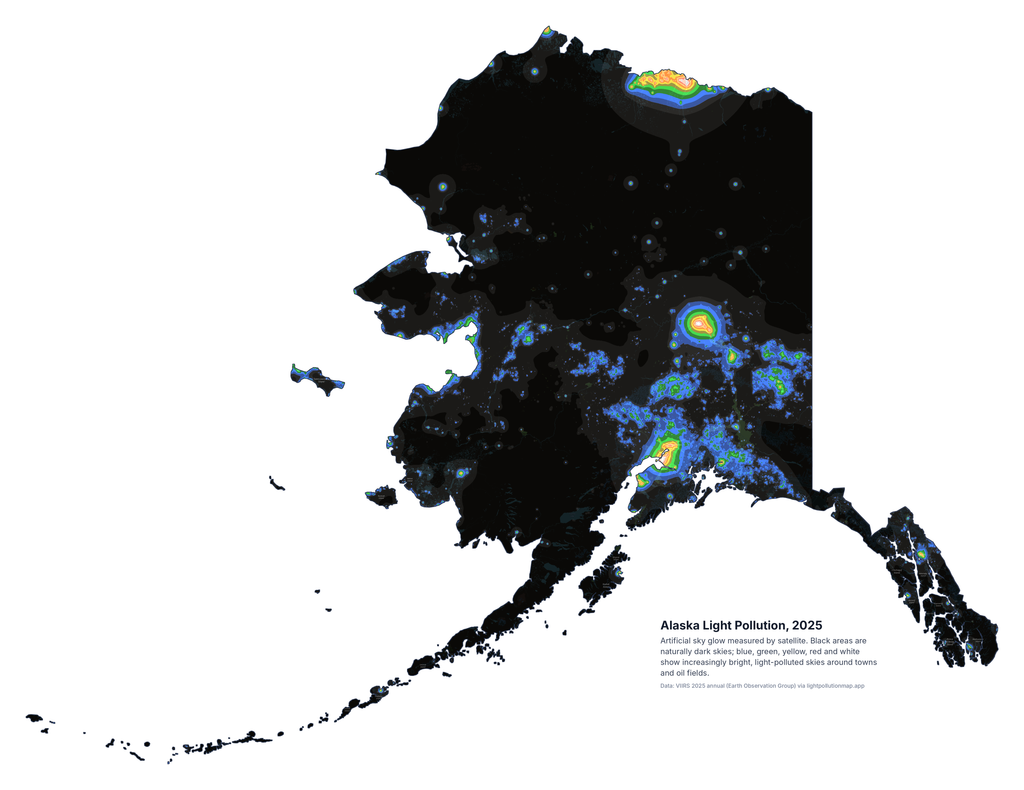
Alaska’s light, mapped
Most of Alaska is Bortle 1 or 2. Artificial light is concentrated in a few places: Anchorage and the Mat-Su, Fairbanks, the North Slope at Prudhoe Bay, Juneau and the regional hubs. Downtown Fairbanks was the brightest point measured, at 17.18 (Bortle 9). For most visitors, near-pristine skies are less than an hour’s drive from where they’re staying.
The darkest drives
Each major highway has stretches that rival the best skies in North America:
- Dalton Highway: Wiseman to Chandalar Shelf (about MP 189–235), Bortle 1
- Richardson Highway: Sourdough to Paxson, Bortle 2.2
- Seward Highway: Kenai Lake to Trail Lake, Bortle 2.4
- Parks Highway: north of Healy, Bortle 2.5
- Glenn Highway: near Tolsona, Bortle 2.6
How Alaska compares
The western United States, from the Missouri River and the Plains to the Pacific, has 117 DarkSky places. Utah has 32, and Colorado and Arizona have 23 each. Alaska has none.
Alaska’s skies are not the reason. Several International Dark Sky Park candidates you can reach by road read are already near the top (darkest skies) of the Sky Brightness scale:
- Wrangell–St. Elias, 21.99
- Denali, 21.98
- Steese and White Mountains, 21.98
- Tetlin, 21.97
- The Denali Highway, 21.96
- Kenai Fjords, 21.93
Wrangell–St. Elias reads darker than all 61 certified Dark Sky Parks in the western Lower 48. The median Alaska candidate (21.93) is darker than the median certified western park (21.86). What Alaska lacks is winter access, night programs and better outdoor lighting.
Paths to certification
DarkSky certifies several types of places, and each has its own requirements. This post highlights the two strongest Alaska candidates for each type:
- Reserve (a dark core surrounded by communities that adopt lighting plans): Denali’s year-round entrance area with the Denali Borough, or Wrangell–St. Elias with the Copper River Basin
- Sanctuary (remote and pristine): Gates of the Arctic, or Wood-Tikchik State Park
- Community (a town that adopts a lighting ordinance): Gustavus, or Eagle
- Urban Night Sky Place (a park near a city of 10,000 or more): Eaglecrest in Juneau, or Chena Lake Recreation Area near Fairbanks
Lodges can also apply on their own through DarkSky’s new Approved Lodging and Resort programs. Some lodges that come to mind that operate in the winter would be Borealis Basecamp north of Fairbanks, The Lodge at Black Rapids on the Richardson Highway south of Delta Junction, or Boreal Lodging in Wiseman. There are many, many more that could be designated.
Local lighting decisions matter
No Alaska city or borough has a dark-sky lighting ordinance today. Five local governments would unlock or protect the most candidates:
Several of the darkest areas have no local government at all. Wrangell–St. Elias, McCarthy, Wiseman and the darkest stretches of the Richardson and Dalton highways are all in the Unorganized Borough. Protecting those skies depends on the State of Alaska and federal land managers.
- Denali Borough
- Fairbanks North Star Borough
- Matanuska-Susitna Borough
- Kenai Peninsula Borough, with the cities of Seward and Homer
- City of Gustavus
The business case
Outside estimates astrotourism at about $10 billion a year and says it could double by 2035. On the Colorado Plateau, dark-sky tourism is projected to bring in $5.8 billion over 10 years, including $2.4 billion in wages and more than 10,000 jobs. Compare that to the total annual value of tourism in Alaska at $5.6 billion, most of which is in the summer.
Night-sky visitors also stay overnight. One study found that a day-trip visitor spends about $90, compared with up to $300 for an overnight stay. Certification pays off too. Scotland’s Galloway Forest returned £1.93 for every £1 spent, and Bryce Canyon’s astronomy-related revenue grew from $1.1 million to $1.7 million.
The pool of potential visitors is large. About 80% of Americans can’t see the Milky Way from home, and sky brightness is rising about 9.6% a year. Media coverage of the solar maximum showed how quickly night-sky news can drive travel interest. In Alaska, though, the aurora shows up every winter regardless of the solar cycle, so that interest is something to build on. DarkSky’s principles of responsible astrotourism can help that growth protect the resource it depends on.
Health and wildlife
Dark skies matter beyond tourism. Artificial light at night suppresses melatonin and disrupts sleep, although DarkSky notes that the health effects of outdoor lighting specifically are not yet proven. About 80% of North American migratory birds migrate at night, and up to a billion birds die in building collisions in the U.S. each year. Lighting can also disrupt wildlife and ecosystems more broadly. Good outdoor lighting is shielded, aimed down, warm in color and used only when needed. It protects the sky, saves energy and costs little.
Get the full presentation
To learn more, join Alaska Photo Treks owner Carl Johnson as he leads a panel discussion on this topic at the Alaska Travel Industry Association’s annual convention next week in Fairbanks. Check the convention schedule to learn when and where to see it. The full presentation includes the maps, highway profiles, candidate analyses and comparison charts. Download the full length presentation (PDF)
Sources
- lightpollutionmap.app: 2025 VIIRS annual data (Earth Observation Group)
- DarkSky International: Place types, How to apply, All places
- DarkSky International: 3 Benefits of a Dark Sky Designation, Roadless Rule, Guatemala astrotourism, Responsible astrotourism
- DarkSky International: Human health, Wildlife and ecosystems, Lights Out for the birds
- Outside: Why dark-sky tourism is growing, Best places for astrotourism in 2026