
Environmental advocates argue releasing wastewater violates the spirit of transboundary agreements
“It is a morally binding agreement.”
For advocate and Fort Smith resident Don Jaque, those words define the duty held by provincial, territorial, and federal leaders to protect downstream ecosystems from toxic oilsands tailings being released into the Athabasca River system.
Jaque says the Government of the Northwest Territories as a whole must step up and make protecting shared waters an urgent political priority before any wastewater is discharged upstream.
He says the Mackenzie River Basin Transboundary Waters and N.W.T.-Alberta Bilateral Water Management Agreements can be used as tools when it comes to the environmental and health concerns the release of tailings pose.
Though the agreements carry no legal penalties, Jaque stresses the ethical duty to safeguard northern waters remains clear — especially as pressure mounts across downstream communities.
On Oct. 11, advocacy group Alternatives North — with contributions from Jaque — sent a letter to N.W.T. Environment and Climate Change Minister Jay Macdonald, urging the territorial government to act before any wastewater is discharged into the watershed. The letter warns that approving Suncor’s plan could set a precedent for seven other major oilsands operators in northern Alberta, sending cumulative tailings throughout the entire Mackenzie River basin.
“The federal and Alberta governments have a responsibility to deal with those tailings, and dumping them in the river is not the way to do it,” Jaque said. He added that major energy companies have the capital to build closed-loop recycling systems, warning that proposed pipeline expansions will double oilsands capacity and compound tailings volumes.
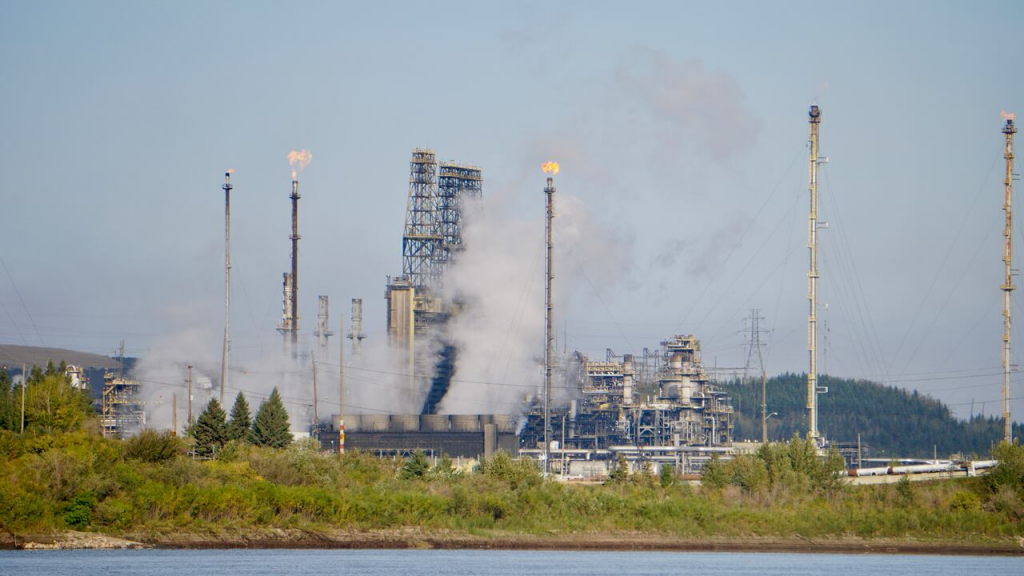
Tailings ponds built over the past 60 years contain toxic mixtures of organic acids, heavy metals and fossil fuel deposit remnants. Downstream First Nations, Métis, and territorial communities draw drinking water from Lake Athabasca, the Slave River and Great Slave Lake, raising acute concerns over chronic exposure to bioaccumulative toxins through municipal supplies and foods.
“The record of the federal government in dealing with the health of people living downstream and even living in Alberta has been very poor,” Jaque said, noting Ottawa has never conducted a comprehensive health study in Fort Chipewyan despite high reported rates of cancers. “They have been negligent.”
In September, several residents in Fort Chipewyan protested Suncor’s plans to treat and release tailings, describing their actions as “environmental racism.” Indigenous leaders have also raised concerns about the Alberta Energy Regulator’s (AER) historical negligence with tailings management.
According to the Alternatives North letter, the Alberta Energy Regulator stated Suncor’s project would “not require a formal Environmental Impact Assessment.” Suncor’s annual filings from 2022 to 2025 describe its filtration technology as “improving,” offering no proof that treated effluent is safe.
Former N.W.T. environment minister Michael Miltenberger, who helped draft the 2015 N.W.T.-Alberta Bilateral Water Management Agreement, pointed out that Alberta has a “sketchy history with good science, not manipulated science,” when it comes to tailings ponds.

“The battle is lost if you can’t — in our confederation and collaborative approach — work it out and there’s irreconcilable differences, then we’ve done something wrong in terms of process,” Miltenberger said. “Nobody can walk away from the table.”
Minister Macdonald affirmed the territory remains aligned with concerned communities, maintaining its opposition to wastewater discharge until scientific uncertainties are resolved.
“We do not support treat and release, and that position won’t change until we are very, very clear that all of the requirements and the science is there to support that as an option,” Macdonald said, emphasizing that primary regulatory authority rests in Ottawa. He said the territory is responsible for contributing data to help the federal government make regulatory decisions, but has no final control over it.
Former N.W.T. deputy environment minister Ernie Campbell emphasized that bridging the gap between technical data and local communities requires better communication, including translating complex scientific studies into plain-language reports.

“When these technical reports are produced, why don’t we have plain language reports?” Campbell said, noting that N.W.T. water strategies have successfully used this approach to build trust with Indigenous communities.
Campbell stressed that finding solutions requires meaningful participation from all levels of government, industry, Indigenous leadership and community, rather than rushing major decisions.
He says Indigenous communities want development and growth to happen but there’s a collective standard that he says needs to be in place.
“We’re not just saying stop,” Campbell said. “We’re not saying we don’t want it … all we’re saying is let’s hear each other and let’s do it right.”
Related stories from around the North:
Canada: Cyanide detected in creek after Victoria Gold’s heap leach failure at Eagle gold mine, CBC News
Russia: Oil company tried to cover up large Arctic oil spill, The Independent Barents Observer
Sweden: Swedish developer GRANGEX buys iron ore mine on Norway’s border to Russia, The Independent Barents ObserverUnited States: Canada and U.S. make co-investment in Fortune Minerals N.W.T. project, The Canadian Press