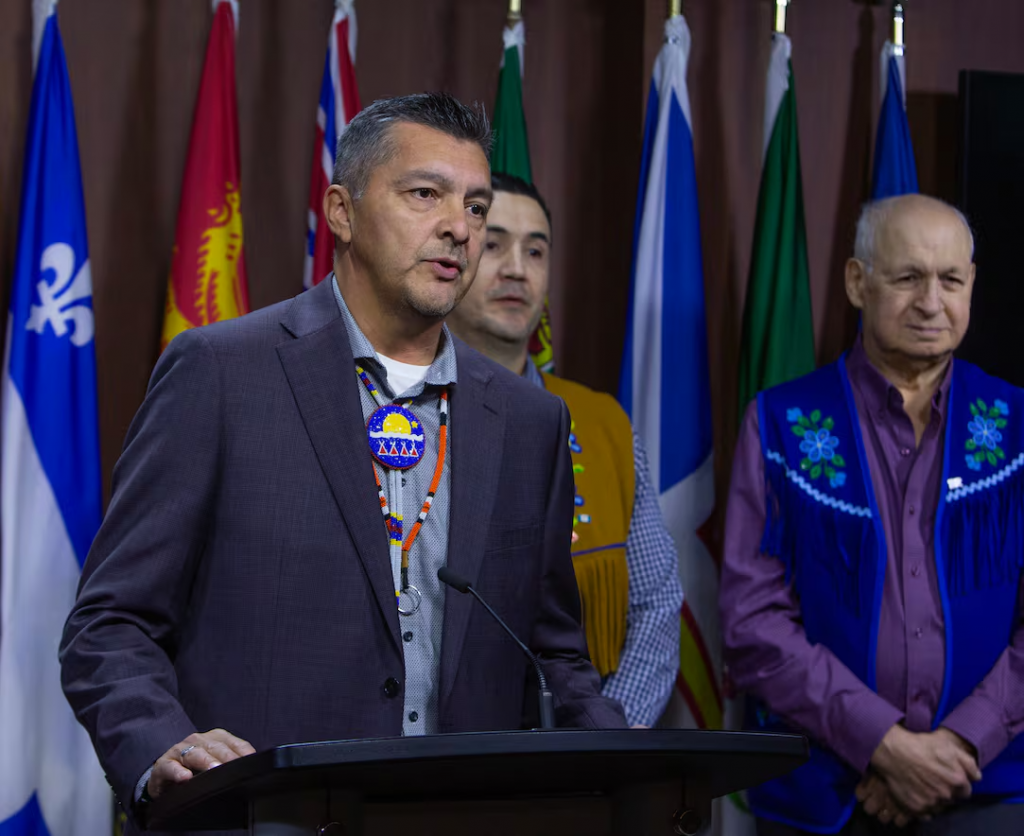

Premier, Indigenous leaders say northern development must come from shared decision-making
Leaders from across the Northwest Territories spoke in Ottawa Tuesday, demanding federal investments in northern infrastructure, transport and clean energy as the region faces an impending shift away from its historical economic drivers.
The N.W.T. Council of Leaders — representing territorial ministers alongside First Nations, Métis, and Inuvialuit leaders — urged Ottawa to support Indigenous-led major projects.
Among the priorities presented to federal ministers are the Tłı̨chǫ and Yellowknives Dene-led Arctic Economic and Security Corridor, the 800 kilometre Mackenzie Valley Highway extension to Inuvik, the Taltson Hydro Expansion and the Inuvialuit Energy Security Program.
One of the calls comes as the territory prepares for the eventual closure of its major diamond mines, including Ekati, Diavik, and Gahcho Kué, which has contributed to the local economy for decades.
“The mines are all dying out — the diamond industry,” said N.W.T. Métis Nation President Garry Bailey. “We’re finding new ways to do it to sustain ourselves.”
Territorial leaders pointed to long-standing federal underfunding as a primary obstacle to that economic transition, noting that the territory has historically lacked the basic national infrastructure found in the rest of the country.
“It’s been underinvested [in], Canada’s North,” said N.W.T. Premier R.J. Simpson. “We haven’t had the infrastructure investments that you see across southern Canada … We’re finally now at the cusp of getting those things so that we can become contributors to Canada and we can better serve our population.”

Rather than traditional top-down development, territorial and Indigenous officials emphasized that replacement industries must be built through shared decision-making.
Tłı̨chǫ Grand Chief Jackson Lafferty emphasized that major initiatives across the territory are already either Indigenous-led or executed in partnership with local nations. “We are leading the pack,” Lafferty said. “We’re leading the projects, and we’re part of the decision making today.”
He also said that federal policies often fail to account for the unique governance structures and operating realities of the North.
“It has to be a northern solution,” said Lafferty. “We as leaders across the Northwest Territories have all the solutions that we can offer — it’s just a matter of tying that up with federal ministers and their departments.”
The Council representatives stressed that economic expansion cannot be decoupled from pressing social needs, citing high living costs, housing shortages, medical travel expenses and substance abuse crises across the territory’s 33 communities.
“It has a ripple effect on the health and well-being of our communities,” said Lafferty.
Premier R.J. Simpson added that high operating costs mean “a dollar in the Northwest Territories doesn’t go nearly as far as it does in Southern Canada,” leaving territorial and local governments stretched thin as they try to deliver essential services.
Caroline Wawzonek, minister of strategic infrastructure, energy and supply chains, closed by saying long-term funding commitments are critical to seeing infrastructure through to completion, pointing to past projects left unfinished when national political attention drifted.
“We’re not letting our feet up off the gas. We’re going to make sure that we do our part to see these projects through, and we’re here to make sure that Ottawa does the same,” Wawzonek said.
Related stories from around the North:
Canada: N.W.T., Yukon mining and energy projects get boost at Canada Investment Summit, CBC News
Finland: Lapland among regions not in favour of wind power compensation for eastern Finland, Yle News
Greenland: Greenland rules out winter 2026-27 drilling for Nunap Qeqqa/Jameson Land oil project, Eye on the Arctic
Russia: Europe boosts LNG trade ahead of the ban, The Independent Barents Observer
Sweden: Electricity prices climb in Sweden as Russian gas pipeline goes offline, Radio Sweden
United States: ‘You just move forward’: Greenland Energy oil exploration delayed by a year, The Canadian Press