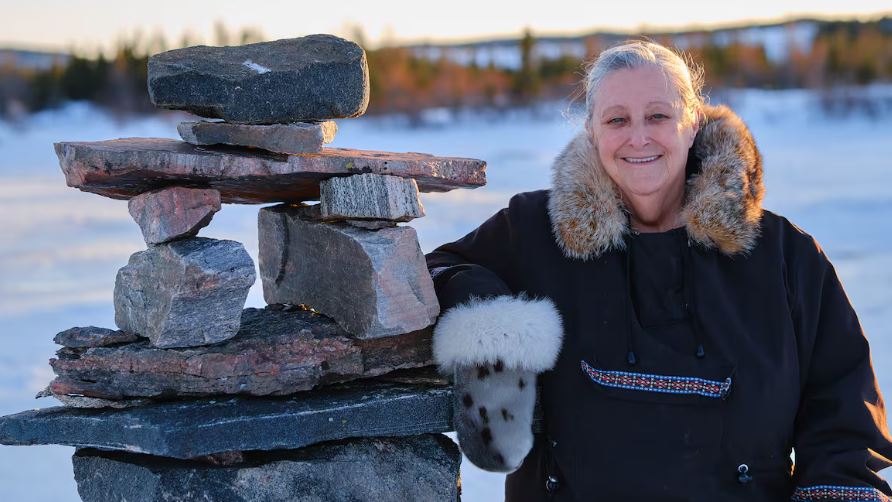
Rigolet’s Charlotte Wolfrey co-chairs Newfoundland and Labrador’s Indigenous Women’s Reconciliation Council. She said the province’s declaration last week of gender-based violence as an epidemic is a long time coming. (Eldred Allen/Bird’s Eye Inc)
By Samuel Wat
For Charlotte Wolfrey of Rigolet, N.L., ending gender-based violence is personal.
Her daughter was murdered in 1993, and she has watched others in her circles die the same way.
Seeing the Newfoundland and Labrador government last week declare gender-based violence an epidemic fulfills one of her long-time calls to action.
“We’ve been fighting hard to try to get this heavy topic talked about out in the open,” she said.
Wolfrey is one of 12 people named to a task force set up to guide the province’s response.
Wolfrey believes there’s still a stigma with talking about both physical and mental violence, and she wants to change that.
“Not everybody wants to get involved in everybody’s business. It’s not seen as a community problem, it’s almost like it’s still in your personal household,” she said.
Statistics Canada figures show that among the provinces, Newfoundland and Labrador had the third-highest rate of intimate partner and non-intimate partner violence in 2024.
Stacey Hoffe, the executive director of the Mokami Status of Women Council, is also on the task force.
Hoffe said the use of the word “epidemic” to describe gender-based violence is powerful as it recognizes it’s a vast and pervasive issue. She also sees the declaration as an opportunity for the province to reorient its priorities.
“This announcement is the work of many, many Indigenous leaders, community leaders, advocates, feminist advocates, and most importantly, survivors,” she said.
Multi-layered response
Wolfrey said she was once in a violent relationship herself. She fortunately had the means to leave, but not everybody has that.
She said the lack of services and safe spaces in remote northern communities further amplifies those challenges.
To address that, Hoffe said it’s important to look at the wider picture – child care, housing, policing, access to justice, and education about consent.
She said she will push the province to remain focused on listening to the people most affected by gender-based violence.
“It’s really important that we move away from a colonial, patriarchal, prescriptive way of addressing gender-based violence,” she said.
It was a big milestone in the Senate Tuesday night for two Newfoundlanders who are pushing for a bill on intimate partner violence.
As the CBC’s Ariana Kelland reports, it’s a moment they’ve been through before, but this time they say it’s different.
Ending gender-based violence has been a longstanding goal of provincial governments.
A previous Liberal government established a committee on the issue in 2017, under former justice minister Andrew Parsons.
In early 2025, Pam Parsons, the former minister for women and gender equity, also announced a ministerial committee to end gender-based violence.
For Hoffe, a declaration is meaningless without action. She said there are existing resources out there for the government to start on immediately.
“I think about the National Inquiry into Missing and Murdered Indigenous Women and Girls,” she said. “That is a road map. The voices have been very clear about what needs to happen.”
Related stories from around the North:
Canada: Delay on gender violence action plan a “disappointment,” says Canadian Inuit women’s org, Eye on the Arctic
Finland: Swedish-speaking Finnish women launch their own #metoo campaign, Yle News
Sweden: Report sheds light on Swedish minority’s historic mistreatment, Radio Sweden
United States: Alaska reckons with missing data on murdered Indigenous women, Alaska Public Media