The Alaska House of Representatives has voted to advance a multibillion-dollar tax break for the proposed trans-Alaska natural gas pipeline project.
The House’s 34-5 action sends the tax break to the state Senate, which is expected to take up the issue next week. Legislators are in a 30-day special session devoted to the issue, and the session ends June 19.
House Bill 381, containing the tax break, doesn’t guarantee pipeline construction, but project skeptics and advocates alike say that without the change, the pipeline is uneconomic.
“I’m very proud of us getting this bill to where we are today and giving this project a fighting chance,” said Rep. Calvin Schrage, I-Anchorage, “so that Alaskans and hopefully the world can benefit from the gas reserves that we have here in the state.”
If enacted, the bill would replace the state’s 2% petroleum property tax with a tax on gas shipped through the pipeline.
Proceeds from the petroleum property tax are split between boroughs and the state. If the pipeline is built, those governments would collectively forego about $800 million per year, said Rep. Andy Josephson, D-Anchorage.
The state would still collect royalties, corporate income taxes, production taxes and other fees, said Rep. Chuck Kopp, R-Anchorage. Those are expected to net the state between $600 million and $700 million in new revenue per year.
HB 381 also contains a rate cap to mandate that pipeline developers provide natural gas to Southcentral Alaska residents at a price that’s lower than the predicted price of imported gas.
Currently, Southcentral Alaska relies on natural gas from fields beneath Cook Inlet. Available supplies are running low.
“I think everyone’s been asking: What is the benefit to Alaska?” said Rep. Sarah Vance, R-Homer. “The benefit, if you could summarize it into one thing, and that’s reliable energy.”
Other parts of the bill mandate an impact fund to compensate local governments for the effects of construction, and send money to a rural power fund to pay for energy projects away from the pipeline.
“Every region of Alaska will get a share of this project one way or the other, and there’s real protections for Alaska ratepayers,” Kopp said.
Gov. Mike Dunleavy and Glenfarne, the multinational firm developing the pipeline, issued written statements after the vote, praising lawmakers’ action.
“This project has the potential to transform Alaska’s economy for decades,” the governor said in part. “I look forward to working with the Senate to get this important legislation across the finish line.”
As currently planned, the Alaska LNG project would be built in two phases. The first phase would include a pipeline from the North Slope to Cook Inlet, with limited processing plants needed to deliver gas to Southcentral Alaska for domestic use.
Glenfarne expects to begin operating the first phase by 2029.
The second phase would involve building a large facility on the North Slope and another on the Kenai Peninsula, allowing the pipeline to ship larger volumes of gas for export overseas.
Glenfarne expects the second phase of construction to be done in 2033 and that both phases will cost between $44.5 billion and $54.5 billion altogether.
Exports would subsidize the cost of gas for in-state use, with Glenfarne projections suggesting that if the pipeline reaches full capacity, the cost of gas in Southcentral could be half of what it is today.
That’s still hypothetical. Estimates from the Alaska Department of Revenue suggest the pipeline project’s economics are marginal. Even if the tax break is adopted, the cost of exported gas may not be competitive on global markets with gas from other sources around the world.
“We cannot control global economics, and the passage of this bill does not guarantee a pipeline will be built. I think that’s important to recognize,” said Rep. Zack Fields, D-Anchorage. “This bill absolutely increases the likelihood that the project can progress.”
Under the terms of HB 381, pipeline developers would pay no gas tax for the first five years of the project, or until gas volume reaches a certain, export-level threshold.
After that point, the new tax would kick in.
Because boroughs are forgoing so much revenue, HB 381 requires the pipeline developer to pay $80 million into an impact fund that would be distributed to boroughs — including Anchorage — along the route.
That money might be used to pay for extra street repairs, additional police or other services needed to address the needs of thousands of extra workers who would be building the pipeline.
Rep. Dan Saddler, R-Eagle River, said he’s heard from Alaskans who think HB 381 is a giveaway and that the state could pull in hundreds of millions more if it simply left the property tax alone.
“I shake my head and tsk just a little bit,” he said, “because a high tax on no pipeline gets you no money; a lower tax on a real pipeline gets you money.”

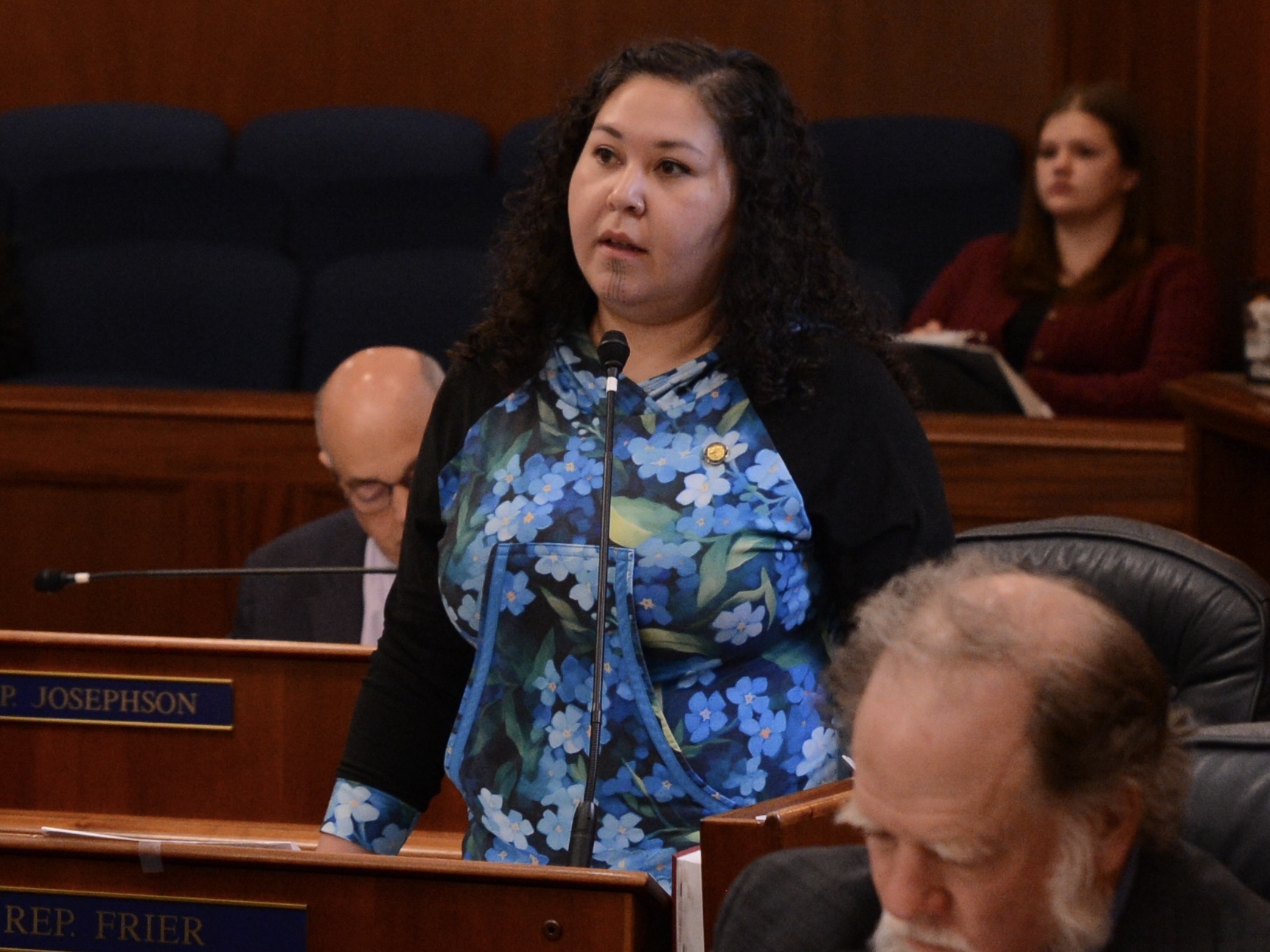
Rep. Robin Frier, D-Utqiagvik, opposed the final version of HB 381. She represents the North Slope Borough, which relies heavily on the petroleum property tax for local needs. The borough would forego hundreds of millions of dollars in prospective revenue under a switch to a gas tax.
Before Friday’s final vote, she offered a pair of amendments that would have reduced the impact on the North Slope. Both were defeated by wide margins.
Rep. Donna Mears, D-Anchorage, was excused absent from Friday’s vote because of travel problems that kept her from reaching Juneau.
By text message, she said that had she been present, she would have voted against the bill.
“This legislation will push costs down onto communities and lock us into tax breaks we won’t be able to re-evaluate for decades,” she said.
Rep. Sara Hannan, D-Juneau, also voted against the bill, saying her constituents raised climate change concerns. Burning natural gas releases greenhouse gases, which contributes to climate change.
Rep. Jeremy Bynum, R-Ketchikan, offered a different perspective, saying that he believes cheap natural gas will displace diesel fuel, thus leading to an overall reduction in greenhouse gas emissions because gas is cleaner burning than fuel oil.
Fairbanks Democratic Rep. Ashley Carrick borrowed a term from public health and said that natural gas is an issue of “harm reduction.” In her district, many people heat their homes with fuel oil at $6 per gallon. When oil isn’t available — or is unaffordable — people burn wood.
“Fairbanks has some of the worst air quality in the nation, in the world, because of those fuel sources. Natural gas is harm reduction. I believe in that, and while I do share the frustration and concern from many, I believe this is a step in the right direction towards more sustainable energy, available energy and affordable energy for our communities,” she said.
Saddler, who is retiring from the Legislature this year, said he hopes lawmakers “can bring an end to that old joke that a natural gas pipeline is Alaska’s future and it always will be. I hope you never hear that joke again.”
YOU MAKE OUR WORK POSSIBLE.