Steelhead research is expanding on the Kenai Peninsula, and the data is starting to reveal where these fish go once they leave freshwater. Trout Unlimited’s Alaska chapters are funding satellite tagging efforts alongside ADF&G and UAF researchers to fill in the gaps on ocean migration, predation, and what that means for long-term steelhead management.
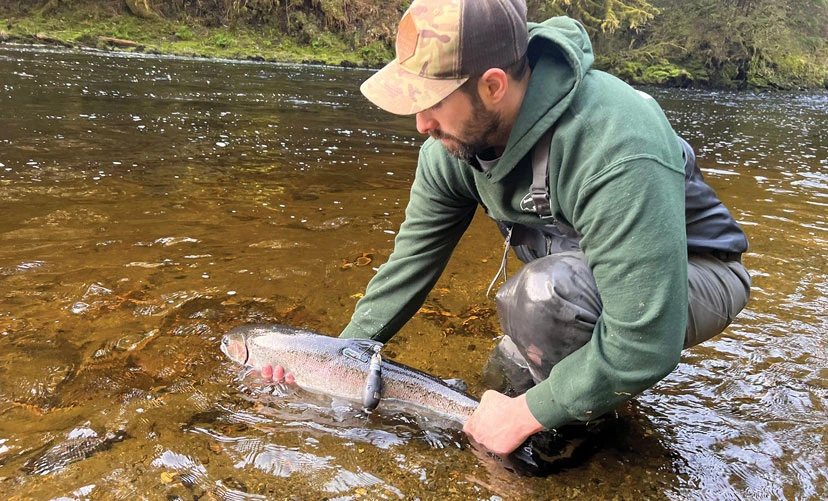
Ben Gray releases a tagged steelhead from Prince of Wales Island. © Joe Spencer
Trout Unlimited Invests in Alaska Steelhead Research By Chennery Fife
The mighty steelhead has always captured the imaginations of anglers, especially those who are lucky enough to have a successful struggle with this powerhouse species. But relatively little is known about these beloved fish. That’s why Trout Unlimited (TU) Alaska chapters jumped in on a multiyear investment in steelhead research. In 2024, Trout Unlimited’s Kenai Peninsula and Southcentral Alaska chapters funded an extra month of data collection at the Anchor River weir. The weir is primarily used to count salmon populations. The extension provided the first full count of the river’s steelhead population.
“The steelhead reminds the angler that strength lives in the journey, and hope rises with every cast.”
– Jason Amaro, Trout Unlimited’s Southcentral Alaska chapter membership coordinator
Steelhead are genetically the same species as rainbow trout, but there are significant differences in their life cycles. Steelhead spend two- to three years in freshwater before heading out to the ocean. Like salmon, they return to their natal streams to spawn after one- to three years in the ocean, but unlike salmon, they can spawn multiple times. Kelts are steelhead that survive spawning and return to the ocean. Some steelhead can repeatedly spawn up to as many as five times.
Anchor River weir data provided a baseline for steelhead returning to freshwater, but little is known about steelhead in the ocean. Mike Booz is the Homer area manager for the Alaska Department of Fish & Game (ADF&G) who worked on the Anchor weir study. When he was asked what his ideal steelhead study would be, he didn’t hesitate to respond: a satellite telemetry study.
You can imagine the shared delight when Booz told TU a year later that ADF&G is teaming up with researchers Michael Courtney and Dr. Andy Seitz from the University of Alaska – Fairbanks, to do a satellite-telemetry study on Lower Kenai Peninsula steelhead.
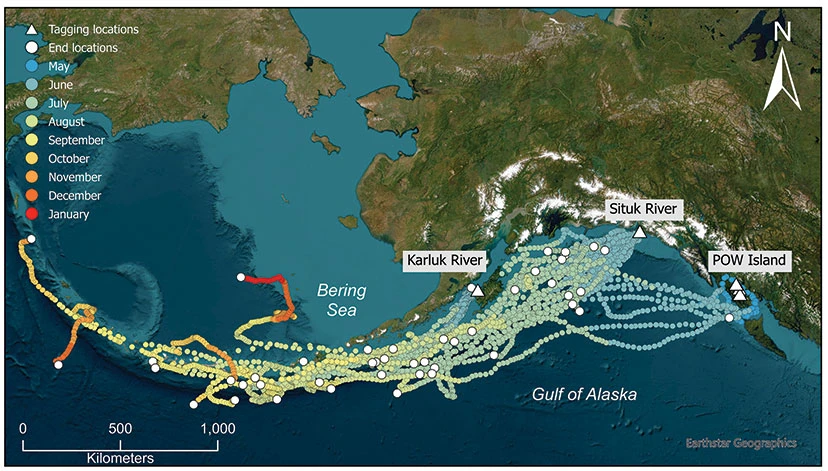
End locations of the satellite tags (white dots) attached to steelhead, from the Situk River, Prince of Wales Island, and the Karluk River. Circles color-coded by month denote daily locations of tagged steelhead estimated by model. © Michael Courtney
Tagging Research
Courtney and Seitz have been studying salmonids, including Dolly Varden, Chinook, and steelhead, via pop-up satellite archival tags for over 13 years. These tags help them understand their behavior, migration, and ecology in the ocean.
Satellite archival tags gather data every few minutes and archive it until they detach from the fish, float to the surface and transmit the archived information to overhead satellites. The end location tells the research team where the tag came to the surface. Using depth, light, and temperature information, the researchers can ascertain water temperatures and diving behavior, estimate ocean migration routes and infer when and how some fish die.
Their steelhead research has been focused on the Situk River, the Karluk River, and along the east coast of Prince of Wales Island. The high cost of $4,000 per tag limits the amount of steelhead they are able to study. Since 2018, they have tagged 93 steelhead, which yielded 3,000 days of invaluable data.
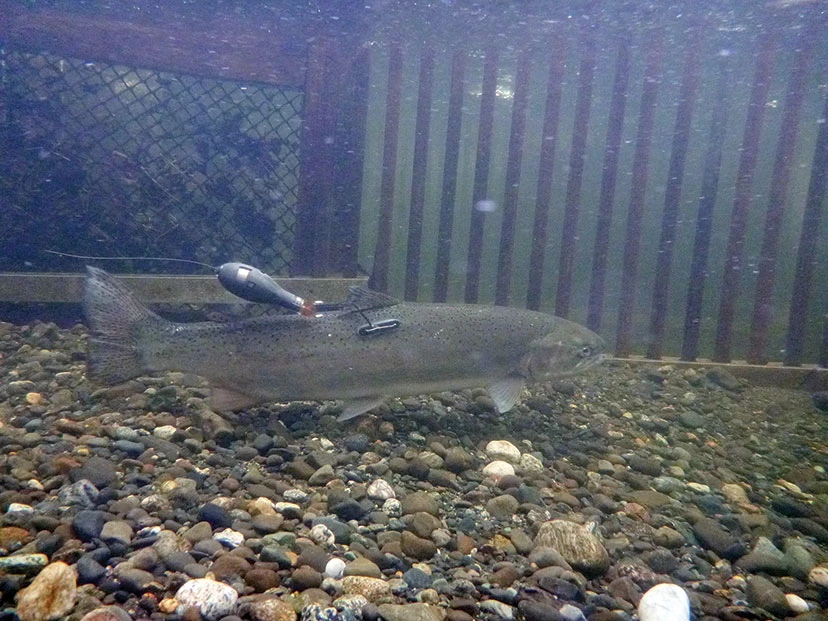
Situk River steelhead tagged with a pop-up satellite archival tag. © Andy Seitz
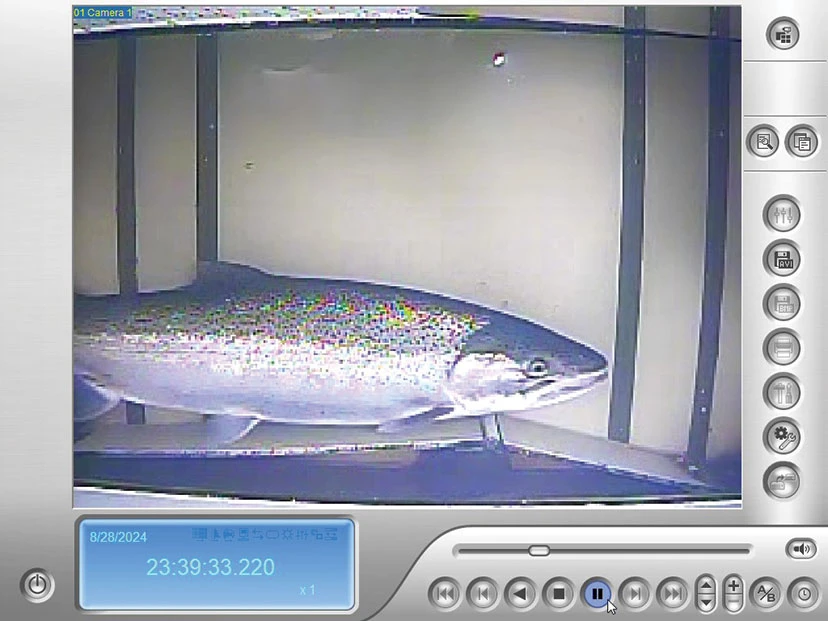
Steelhead returns to the Anchor River through the weir in August 2024. © Dave Atcheson
Results
One of their biggest takeaways is how steelhead generally travel thousands of kilometers to their foraging grounds near the Aleutian Islands. They most likely spend time in deeper, offshore areas of the continental shelf and basin, but also spend time more consistently at the surface. Unlike Chinook that routinely dive to depths of more than 100 meters, steelhead tend to dive only to about 5-10 meters, occasionally going down to 20 meters.
While Courtney and Seitz did not set out to research mortality, the data returned interesting information about how some of these fish die. By taking note of drastic temperature, depth, and light changes, they can infer what might have eaten a fish. Most tagged steelhead died of “unknown” predation. Two salmon sharks ingested steelhead; cold-blooded predators (potentially blue sharks) ate nine tags; and 30 died of unknown causes, potentially a toothed whale, or a seal or sea lion that didn’t swallow the whole fish, so the tag sank to the seafloor.
This information helps paint a more complete picture of predation and mortality, implying that even grown steelhead face dangers in the ocean. The data also helps us understand where steelhead locations overlap with human activities. The researchers can compare migration routes to where there are oil and gas leases and exploration, for instance. This data may eventually aid management decisions that help reduce steelhead mortality.
Future Research
Each season, the scientists are building a more complete picture of the lives of steelhead, while constantly searching for scarce steelhead-specific funding. Trout Unlimited seized the opportunity to support this research to better understand one of the Alaska sport anglers’ favorite species.
Trout Unlimited’s Kenai and Southcentral Alaska chapters have raised $4,000 each for the project, adding two tags that will supply additional valuable steelhead data. The UAF team is excited to partner with ADF&G and TU to expand their tagging efforts to steelhead migrating from the Anchor and Ninilchik rivers.
“Even with the high price tag, the Board felt it fit into the Kenai Peninsula’s Trout Unlimited goals and objectives. As we are all aware, the steelhead is one of the fly fisherman’s favorites to catch. We also thought it was a priority to get ahead of any issues that may affect steelhead numbers, before it is too late. This was one way we could help and be a part of the solution. This is what we do.”
– Roger Sensabaugh, Trout Unlimited’s Kenai Peninsula chapter president
The Kenai Peninsula data will contribute to filling in geographic gaps. But why stop there? Courtney’s team is partnering with other groups up and down the West Coast, from California to Alaska, working towards an ambitious goal of a holistic, range-wide examination of steelhead migration, behavior, and predation throughout their entire North American range.
Courtney’s team will tackle the Kenai Peninsula before tagging steelhead from other populations across the state, with plans to research the remote populations of the Alaska Peninsula. Trout Unlimited is proud to be a part of this vision of comprehensive understanding of steelhead, helping to inform ways we can protect them. If you’d like to support this research, please contact [email protected].
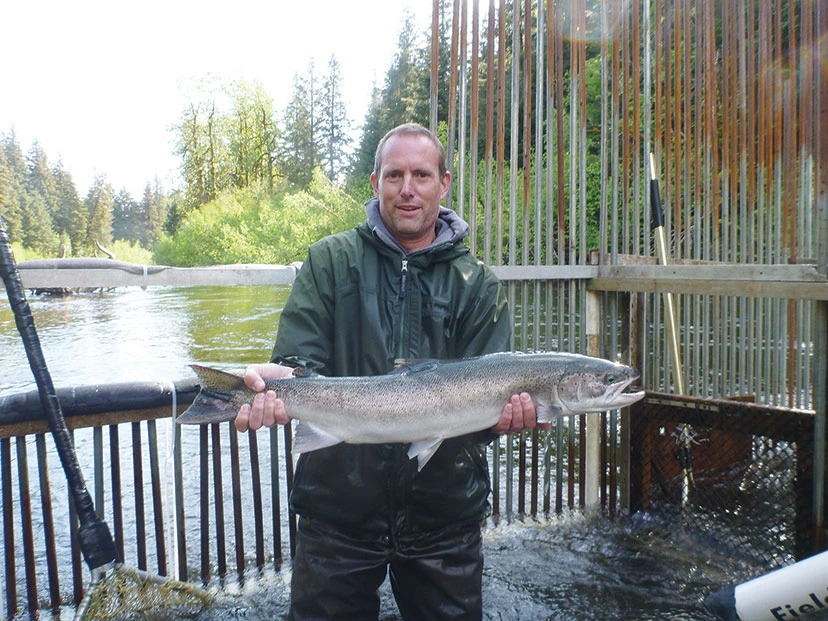
Andy Seitz prepares to release a tagged steelhead on the Situk River. © Michael Courtney
Trout Unlimited’s mission is to protect, reconnect, and restore North America’s cold-water fisheries and their watersheds. Learn about our work in Alaska at prioritywaters.tu.org/alaska.
For more conservation reading, check out Fish Alaska’s Conservation Blog for more.
The post Unraveling the Mysteries of Steelhead appeared first on Fish Alaska Magazine.